By Laura Husband

Four of the 10 worst countries for environmental impact are from the American continent, a new study has found.

The study, carried out at the University of Adelaide, in Australia awarded Brazil and the US first and second place for being the least environmentally friendly.

Ecology expert Corey Bradshaw from Adelaide’s Environment Institute gave countries environmental rankings based on how much they had damaged the environment.

Fisheries were one of seven factors measured that made Brazil the least environmentally friendly country.

The countries were rated using seven factors: Natural forest loss, habitat conversion, fisheries, fertiliser use, water pollution, carbon emissions from land use and threat to species.

These indicators were chosen because there is a lot of evidence to support that they affect ecosystems and quality of life, explained Bradshaw.

From the American continent, Brazil, the US, Mexico and Peru were all listed in the 10 worst countries category along with China, Indonesia, Japan, India, Russia and Australia.

The total wealth of each country was found to be the most important driver of environmental impact.

The top 10 for being most environmentally friendly were, surprisingly, some of the least wealthy countries, mainly from the Caribbean and Africa: Antigua and Barbuda, St Lucia, Grenada, Djibouti, Barbados, Swaziland, St Vincent and the Grenadines, Gambia, St Kitts and Nevis and Tonga.

“There is a theory that as wealth increases, nations have more access to clean technology and become more environmentally aware so that the environmental impact starts to decline. This theory was not supported by our study,” explained Bradshaw.

By Smitha Peter

Recent studies by Natural England and the European Red List reveal that biodiversity is facing serious threats due to loss of habitat.

According to the first study, 480 of the 492 observed species have gone extinct in the past two centuries. The second one says that almost one-third of butterfly species are in decline. Both reports view industrial agriculture as a major factor, along with hunting, pollution and climate change.

Golden eagle - one of the lost species

Golden eagle - one of the lost species. Image credit: J. Glover - Atlanta, Georgia

“Mixed farming or rotational farming is the way forward. Diversity is both a measure of increasing production and conservation of nature,” said environmentalist Dr Vandana Shiva in her speech ‘Perils of the industrial agricultural system’ at the Gaia Foundation in London.

She added that small-scale farming is the most sustainable way for agricultural production.
The European Red List report suggests that the shift from traditional farming methods have especially hit insect species like butterflies. “New agricultural techniques provide little or no space for wild plants and flowers to grow. Moreover, it is based on monoculture, where the plant varieties cultivated are often not butterfly friendly,” says Malcolm Bridge from Butterfly Conservation.

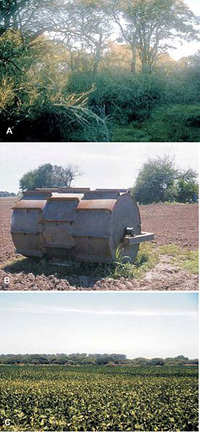
Forest cleared for soybean cultivation

Forest cleared for soybean cultivation. Image credit: Marcelo R. Zak

A study by the Centre for Ecology and Hydrology (CEH) on soil organisms also had interesting results. It stated that although the number of soil bugs increased by 47 per cent in the past 10 years, diversity of bugs has decreased by 11 per cent.

However, scientists warn that further research is needed to be sure of the trend, as the effect of land management, pollution and climate change on soil bugs is not clearly known. The study also observed that there is no significant increase in the number of bugs in arable land, probably due to the regular disruption of their habitat. Diversity of organisms helps the soil cope with pollution and changing weather conditions.

Industrial agriculture is designed to obtain maximum output from minimum input by utilising technological advancements. Production of cheap and plentiful food is viewed as its main benefit.

Audio clip: Adobe Flash Player (version 9 or above) is required to play this audio clip. Download the latest version here. You also need to have JavaScript enabled in your browser.

By Jennifer Green

Marketed as a solution to environmental degradation and our dependence on peak oil, biofuels once appeared a promising ‘green’, renewable energy source. Research bodies worldwide published data supporting biofuel use, claiming they can reduce carbon dioxide emissions.

As a result, governments have subsidised a biofuel boom, providing tax incentives to drive a global expansion. The aim? To create thousands of jobs and reinvent the economy of the developing world. The Malaysian biofuel industry provides a model illustration of this, employing over 570,000 workers within its palm oil industry and racking up more than £12 billion export earnings last year.

Yet biofuels have become increasingly unpopular; with sceptics blaming the industry for jeopardising, what the Royal Society recently described as “one of this century’s key global challenges,” food security.

A bus that is powered by biofuel

It’s not surprising. Covering an eighth of Malaysia, oil-palm trees are cultivated on over 4.5 million hectares of land. But supply has grown slowly, while demand has soared. The result? A 70 per cent jump in oil prices last year, leaving locals unable to afford oil-based consumables.

The problem is not restricted to Malaysia. Few people dispute there is a global food crisis. In the three decades leading up to 2005, world food prices fell by three-quarters, according to the Economist food prices index. Yet from 2005 it took only three years for prices to rise by 75 per cent, with many crops reaching record highs in 2009.

As a result, violent protests have plagued many developing countries. In 2008, Haiti made headline news after food riots spread across the country. Most Haitians earn no more than $2 a day and struggled to feed themselves as the prices of rice and beans rose by 50 per cent.

And with the added concerns of climate change and a growing global demand for meat and dairy products, economists warn that prices are set to rise further.

As the situation deteriorates, the debate over what role biofuel expansion has played in accelerating price rises has intensified. In July 2009, the World Bank released a report blaming US and EU biofuel policies for causing between 70 and 75 per cent of food price escalation.

“Without the increase in biofuels, global wheat and maize stocks would not have declined appreciably and price increases due to other factors would have been moderate,” the report said.

However a paper titled ‘Evaluating biofuels’ written around the same time by Tim Searchinger, Princeton University’s agricultural specialist, criticised the degree to which biofuels are accused.

“Biofuel critics…have probably exaggerated,” he said. “Crop prices are a small fraction of the retail food prices paid in grocery stores, and an even smaller fraction in restaurants.”

Still, he accepts the increase has had a detrimental impact on developing countries, “particularly on the roughly one billion people who live on $1 per day or less and who are likely to be already chronically malnourished,” he said.

Biofuel demand has rocketed recently, with one third of US maize crops now grown to satisfy it. And this is set to rise further as the Government and transport sectors are pressured to reach ‘green energy’ targets and continue to finance the industry.

However at a ‘Food not Fuel’ demonstration held in London last year, protestors warned that biofuels made from food crops cannot provide a sustainable energy source as the world population grows and requires feeding.

They focused on the recent incorporation of bioenergy into transport sectors such as the aviation industry, deeming it an exploitation of the poor to support rich lifestyles.

“The aviation industry know they have their secret weapon growing somewhere in the poor world and that is biofuels,” says John Stewart, spokesperson for Heathrow Association for the Control of Aircraft Noise. “Flying is largely a rich person’s game done at the expense of the poor. Land will be taken that is needed for food production in the poor world to grow biofuels.”

However the European Association for Bioindustries (EuropaBio) believes sceptics are concentrating on short-term disadvantages. As much of the developing world survives on agriculture, they defend biofuel production by taking into account the potential effects of climate change.

“Global warming could be considered more of a danger than biofuels,” it was stated in a report published by EuropaBio. “The development of biofuels will bring direct opportunities to developing countries because their production will create many local jobs,” it states.

Even though the biggest effects of biofuel expansion are felt in developing countries, the industry has also begun to revolutionise British farming. The National Farmers Union recognised the economic benefit of a UK farmer converting to biofuel production.

“The biofuels market allows farmers the opportunity to add value to crops that would otherwise be exported at minimum price,” they claim. “The additional production of high-protein feed also reduces the need for imports such as soya and maize from USA, Canada, Brazil and others.”

But the benefits of biofuel expansion could be limited to production. Food prices are now fuelling a rise in the average UK family’s shopping bill of £750 a year, taking its toll on low income families.

With an increasing proportion of land allocated to the production of biofuels it is easy to blame the industry for aggravating food insecurity. Yet biofuels have certainly served one purpose by revealing the fragility of our agricultural system.

The sheer number of farmers who have recently abandoned their crops and turned to biofuel production reveals the true extent of an economic hardship that may not have otherwise been exposed for years.

Whether or not biofuels have accelerated a food crisis, they have certainly highlighted the fact there is one. And now the correct treatment must be applied.

By Charlotte King and Laura Husband

Climate change and the environment did not feature highly in the General Election, with the economy taking centre stage. But at least some of the public must feel concerned about the environment, having voted in the first green MP in British Political history, leader of the Green Party, Caroline Lucas.

Simon and Ed did not agree on a few things.

So what are the three main party’s views on the big issues of the environment and climate change today? Laura Husband and Charlotte King went to the Climate Change debate hosted by the Guardian a week before the General Election to find out: In order of appearance in the first piece of audio, here’s what Greg Clark from the Conservatives, Ed Miliband from the Labour Party and Simon Hughes from the Liberal Democrats had to say on some major climate change issues.

Expanding Heathrow

Expanding London’s Heathrow airport has been a hotly-contested issue. Labour’s general consensus has been ‘for’ the airport, the Liberal Democrats ‘against’ the airport and the Conservatives against but in favour of an airport elsewhere.

Audio clip: Adobe Flash Player (version 9 or above) is required to play this audio clip. Download the latest version here. You also need to have JavaScript enabled in your browser.

Will the Tory-Lib Dem alliance increase air travel to and from the UK? Picture credit: Axwel on Flickr

Climate Skeptics

A number of climate skeptics have spoken out against the existence of man made climate change following the controversial emails sent by a climate scientist from the University of East Anglia stating that some of the tree data was a ‘trick.’ There are also members of the three main parties who admit to being skeptical about climate change. So how do the three main parties deal with climate change skeptism?

Audio clip: Adobe Flash Player (version 9 or above) is required to play this audio clip. Download the latest version here. You also need to have JavaScript enabled in your browser.

Greg had to defend the Tories

Present climate change policy

Prior to the general election, Labour’s carbon emissions policy was to reach a 34 per cent reduction against 1990 levels by 2020. But did the other main parties think this was realistic or indeed enough?

Audio clip: Adobe Flash Player (version 9 or above) is required to play this audio clip. Download the latest version here. You also need to have JavaScript enabled in your browser.

Peak Oil

Peak oil is the point in time when there is no more petroleum in the ground to be extracted. There is uncertainty about when peak oil will be reached, what to do in the mean time and what to do when it is finally happens among the major parties.

Audio clip: Adobe Flash Player (version 9 or above) is required to play this audio clip. Download the latest version here. You also need to have JavaScript enabled in your browser.

Have we reached peak oil or is it yet to come? Image credit: Chad Teer

Commentator at the Guardian George Monbiot asks how we will reduce fossil fuel consumption, in particular oil.

Whether to use the UK’s entire quota of oil before it runs out or whether to save some of it is a dividing question among the major parties.

Audio clip: Adobe Flash Player (version 9 or above) is required to play this audio clip. Download the latest version here. You also need to have JavaScript enabled in your browser.

George Monbiot wrote the book 'Heat'. Image credit: JK the Unwise

Climate modeling

There is debate among scientists about how to measure climate change, and different models produce varying degrees of environmental change. A physicist questioned the model the politicians have been working with and suggests they should be using an alternative, which would be more accurate.

Audio clip: Adobe Flash Player (version 9 or above) is required to play this audio clip. Download the latest version here. You also need to have JavaScript enabled in your browser.

By Laura Husband

Lake Tanganyika in East Africa is at its hottest for 1,500 years and is likely to affect the fish supply of those living in the four countries that surround it, a new study has found.

The study carried out by a team of geologists from Brown University, US took samples from the lake bed to measure its temperature.

Geologists drilled into Lake Tanganyika to measure the surface temperature over 1,500 years

The temperature increased rapidly in the 20th Century and today the surface temperature is a record 26 degrees Celsius. The warming has already affected the ecosystem and the number of fish.

“Our data shows a consistent relationship between the lake surface temperature and productivity including the number of fish,” said geologist and lead author of the study Jessica Tierney.

As the lake’s surface temperature continues to rise, fish productivity is expected to decline and this will affect the fishing industry in the region, explained Tierney.

Lake Tanganyika is one of the richest freshwater ecosystems in the world. The lake divides into levels naturally: the top 100 metres have most of the animal species while the water closest to the lake bed has less oxygen but more nutrients. The ecosystem relies on the two types of water mixing together.

Tierney found that as the lake warms the two levels cannot mix together. This means fish will struggle to get nutrients from the waterbed.

People throughout South-Central Africa depend on Lake Tanganyika’s fish, said geology professor Andrew Cohen.

The climate change models, if accurate, show the warming in the region will only get worse, explained geology professor James Russell.

By Gulnura Toralieva

Kyrgyz journalists don’t cover climate change because of Russian propaganda, general disinterest and prohibitive expenses, said Nurzat Abdyrasulova, director of the civic environmental foundation UNISON.

“Last time, the most popular Russian TV channel showed a documentary that claimed that climate change is just speculation and a lie. After such programmes, many journalists in Kyrgyzstan become convinced that they should not pay attention to this problem and report on it,” Abdyrasulova said.

Poor environmental reporting in Kyrgyzstan is due in part by lack of interest. Image credit: neiljs on Flickr

“They also think that climate change is a product of fantasy from scientists. No journalist has deep knowledge about climate change,” she added.

Lack of interest is also suffocating climate change reporting. A seminar for local journalists organised by UNISON in the beginning of April, aiming to help them report on climate change, stimulated little interest.

“It was really hard to get journalists to take part in the three-day training, [even though] it was led by experienced journalists and scientists, was free-of-charge and even paid for provincial journalists [to come],” Abdyrasulova said. “After confirming their participation they didn’t come and we called them many times to remind them about the event, which was very disappointing.”

“Most environmental reporting is perfunctory, with no analysis of the situation at all. The journalists only use press releases… and never do investigation by themselves,” she added.

To support this opinion, Abdyrasulova mentioned that news on the Copenhagen summit didn’t appear in the media. “There was only one small news item about this event and it looked very weird in comparison with the volume of information presented by journalists in other parts of the world. I couldn’t understand such a silence from the local media.”

Another reason why other environmental issues are poorly covered by journalists is that the government’s policy towards the environment is: “Everything is ok with our environment. We have no factories. Manufacturing died after the Soviet Union’s collapse, so there is no pollution now,” in Abdyrasulova’s words.

The journalists also help the government create an illusion by ignoring environmental reporting,” she said. The other reason is that ecology as a subject is not taught properly in the schools or universities.

As an NGO leader, she also has problems communicating with journalists.

“Frankly speaking, I have never tried to build bridges with journalists. It is really hard to make them be interested in our job and publicise the environmental problems to attract attention from the public and government,” said Abdyrasulova. Last time she organised a press conference on the results of the Copenhagen summit, only two journalists came.

“It is very expensive today to attract media attention in Kyrgyzstan. If you want something to be published you should pay. Environment itself is not interesting to journalists, despite the fact that the public wants and should be informed about the quality of their lives and risks around them,” said Abdyrasulova.

For example, people don’t know about the dangers of old pesticides left by Soviet agricultural organisations. “There is evidence that use of this type of pesticide may cause cancer. But people are not aware of this risk and they not only use them themselves, but also sell them to other farmers,” she claimed.

By Tiffany Stecker

Linking offshore wind turbines together could help make wind energy more reliable, says a study published in the 5 April issue of the Proceedings of the National Academy of Sciences.

Despite abundant wind power resources offshore, wind turbines cannot provide a steady stream of power, due to changes and fluctuations in wind direction and strength. However, wind power output can be made more consistent if turbines are located in places that take advantage of regional weather patterns. Connecting wind power generators on a common power line also helps with regularity, researchers found.

Wind Turbine

“Making wind-generated electricity more steady will enable wind power to become a much larger fraction of our electric sources,” said lead author Willett Kempton, professor of marine policy at the University of Delaware in the US, and director of the Center for Carbon-free Power Integration.

The researchers studied five years of wind monitoring data from 11 stations along the American East Coast.They estimated output from a hypothetical five-megawatt offshore turbine. The team also explored the seasonal effects on power output.

“A north-south transmission geometry fits nicely with the storm track that shifts northward or southward along the U.S. East Coast on a weekly or seasonal time scale,” said researcher Brian Colle.

The researchers found that when a power line connected each site, the overall power output was evened out. Maximum or minimum output was rare.

Currently, no wind turbines are located in U.S. waters, although projects have been proposed.1

Value of species status gauged with ‘biodiversity barometer’

Scientists have calculated that it would cost US$60m (£39m) to learn about the conservation status of millions of species, some that have not yet been identified.

Experts from the International Union for the Conservation of Nature and Conservation International published their article “The Barometer of Life” in Science. “Our knowledge about species and extinction rates remains very poor, and this has negative consequences for our environment and economy,” said Simon Stuart, chair of IUCN’s Species Survival Commission.

Almost 48,000 species have been assessed on the IUCN Red List, costing about $4m (£2.6m) each year.

Only 1.9 million species have been identified in the world, though the estimated number of species is believed to be between 10 and 20 million.2

Climate funding tripled before financial crisis hit

Philanthropic donations for climate change initiatives grew threefold in 2008 from the previous year, according to a study conducted by the Foundation Center in New York.

Donations jumped from US$240m (£155.2m) in 2007 to $897m (£580m). The top donor was the William and Flora Hewlett Foundation, of printer manufacturer fame. The foundation gave almost $550m (£355.7m) to the ClimateWorks Foundation, which seeks to reduce emissions in the sectors with the highest carbon footprints.

The remaining 267 foundations gave a total of $348.7m (£225.6m)- a 45 per cent increase over the total value of donations in 2007.

The 2007 Design To Win report issued by California Environmental Associates states that charities will need to provide approximately $800m (£517.8m) annually to implement the necessary strategies to address climate change. Since the financial crisis hit in late 2008, overall foundation funding has been strained, a trend the Foundation Center expects to continue through 2010.

Tortoises in trouble

Madagascar’s radiated tortoise may become extinct in the next 20 years, say biologists, due to exploitation for food and animal trafficking.

A team of biologists from the Turtle Survival Alliance (TSA) and Wildlife Conservation Society (WCS) surveyed the country’s southern spiny forest. These surveys showed areas once abundant with tortoises now devoid of the species. Local residents also spoke of poachers taking away truckloads of tortoises for meat markets. Poaching camps, with the remains of thousands of radiated tortoises, were also found.

“The rate of hunting of radiated tortoises is similar to the hunting pressure on American bison during the early 19th century, where they were nearly hunted to extinction when they once numbered in the tens of millions,” said Brian D. Horne, turtle conservation coordinator for the Wildlife Conservation Society’s Species Program.

  1. Kempton, W., Pimenta, F., Veron, D., & Colle, B. (2010). Electric power from offshore wind via synoptic-scale interconnection Proceedings of the National Academy of Sciences, 107 (16), 7240-7245 DOI: 10.1073/pnas.0909075107 []
  2. Stuart, S., Wilson, E., McNeely, J., Mittermeier, R., & Rodriguez, J. (2010). The Barometer of Life Science, 328 (5975), 177-177 DOI: 10.1126/science.1188606 []

By Aine Gormley

Legal and moral issues on climate science have made a splash in 2010. This week, a leading climate scientist is suing Canada’s National Post for libel. In the UK, a climate scientist recently lodged a complaint to the Press Complaints Commission about the Sunday Times. The parliamentary inquiry into the behaviour of climate scientists also received ample coverage. But what legal issues surround these cases, particularly in light of the growing campaign for libel reform?

Simon Lewis, a researcher in human-induced climate change at the University of Leeds has filed a 31-page official complaint to the Press Complaints Commission (PCC).

Lewis complains that an article published in the Sunday Times breaches the PCC Editor Code of Practice Point One, Section i, which states “The Press must take care not to publish inaccurate, misleading or distorted information, including pictures.”

The issue is that, in the article by Jonathan Leake, Lewis’ name was apparently used to back up a claim that the science behind the IPCC report was unsubstantiated where it refers to global warming wiping out 40 per cent of the Amazon Rainforest.

This year's controversy surrounding the IPCC report began in 2009 when email were leaked from the Climate Research Unit at the University of East Anglia (pictured). Image credit: ChrisO

But Lewis said that this claim in the IPCC report is “basically correct, but poorly written.” Thus he maintains that his name and the science were misrepresented.

After the complaint was filed, the Sunday Times left a voicemail for Lewis stating, “It has been recognised that the story was flawed.”

Lewis says that, “The Sunday Times should simply take the piece down and issue a retraction and apology.”

The paper has, so far, only changed the online article title, from ‘UN climate panel shamed by bogus rainforest claim’, to ‘The UN climate panel and the rainforest claim’.

There is no legal obligation to be truthful as long as the reputation of the subject is not adversely affected. So, if the article drove an impression to the readers about Lewis’ integrity, he may have grounds to sue for defamation. But, if the paper could then, for example, prove the statement to be true, it may be covered by the defence of justification.

However, Lewis went to the PCC, not the courts. The PCC does insist on a moral obligation for journalists to be truthful. Thus, possible outcomes of this case are that the PCC will insist the Sunday Times editor take action such as publishing a correction or an apology.

George Monbiot is doubtful of this. “Good luck to Lewis, but as the PCC’s treatment of the News of the World phone-hacking scandal suggests, he’s likely to find himself shut out of another closed world – journalism – in which self-regulation manifestly doesn’t work,” Monbiot said in a recent blog post.

In Canada, Andrew Weaver, a climate scientist at the University of Victoria, has taken his case to the next level. He is suing the National Post for libel after they refused to remove online articles that will, according to Weaver, “poison the factual record, misleading people who are looking for reliable scientific information about global warming,” he recently told the Guardian.

According to the lawsuit, the articles make defamatory claims because readers are lead to believe that Weaver conceals scientific data and is driven by a corrupt pursuit to gain government funding.

Complaints to publishers, such as those from Lewis, seem to be occurring more often. But Weaver’s case appears to be the first lawsuit to be filed between a climate change scientist and the media. So is it likely to be the first of many?

Like the UK, libel laws in most of Canada are more plaintiff-friendly than its counterparts in the US. The New York Times Co v Sullivan (1964) case in the US altered the libel laws so that the publisher was only at fault if false information was published out of malice.

The "McLibel" two were involved in the longest running libel case in UK history. Image credit: Spanner Films

In the UK, a paper can be sued for publishing something even if the public has a right to know. It is only considered in defences such as the Reynolds defence, which originated from the Reynolds v Times Newspapers (1999) case. This allows a series of factors to be considered in defence of the publication, such as the urgency of the matter and the tone of the article.

Another defence that the public’s right to know is considered is in the defence of fair comment. But this can be difficult to prove. Clive Coleman, a BBC legal affairs analyst said, “In defending a libel action the difference between a statement of verifiable fact and one of opinion can be crucial.”

But this month saw a historic ruling from the UK Court of Appeal when it was decided that Simon Singh, who was being sued for libel, had the right to use the defence of fair comment, which the judges clarified as honest opinion.

The charity Sense About Science published this button in support of Simon Singh’s case.

Robert Dougans, Singh’s lawyer, said, “the judgment is clear that not only should the courts be ready to find that a statement is honest opinion, but that scientists should be able to engage in debate and research without facing expensive litigation.”

But Singh was defending his own journalism. Whereas Weaver and Lewis have built a case against the actions of journalists.

Perhaps the contrast between these legal and moral issues in science journalism highlights the need for trained science journalists reporting on scientific issues. Or perhaps they highlight the need for libel reform so that scientists and journalists (and those dabbling in both) are able to act in the public interest.

In the wake of his victory, Singh announced that our politicians must act on libel reform. All three major political parties have now pledged reforms of the libel law in their General Election Manifestos.

By Laura Husband

Tourist ships provide “a potential monitoring network for climate change,” said climate change and penguin conservation expert, Dr Tom Hart at a talk held by the Zoological Society in London last week.

Dr Hart, leading speaker at the ‘Polar Conservation and Climate Change’ lecture had just come back from a cruise in the name of science that cost £8,000.

Traditional expeditions need camping equipment and private shipping time, which can cost between £80,000 and £250,000.

Climate change: Cruise ships are the solution not the problem said Dr Tom Hart at a public lecture last week. Photo credit: Sam Pullara

“We should think of cruise ships and tourism as less of the problem and more of the solution,” said Dr Hart. Cruise ships cover more of the Antarctic than scientific bases so we might as well make that data useful, he explained.

But cheap and comfortable living quarters for researchers are not the only benefit of Antarctic tourism.

A breakthrough in technology means tourists can conduct the research by taking holiday pictures of penguin colonies in known areas.

A scanning system designed by Microsoft and University of Oxford can use the photographs to count how many chicks and adults there are in one area hundreds of times every season, not just once from a single expedition.

If we can get an idea of changes to penguin breeding habits and movements we can see how climate change is affecting them and start to make predictive analysis explained Dr Hart.

“There’s a lot we don’t know but a flexible approach. Something that is fast at reacting to climate change may be the answer,” said Dr Hart.

By Julius Goldthorpe

A unique MSc course, which considers the effect urbanisation has on carbon emissions, is set to launch at University College London (UCL) this year, says Professor Yvonne Rydin. It will provide much needed urban planning professionals to a field that is in critically short supply.

The course, which is in Sustainable Urbanism, will tackle the development of urban areas in a bid to reduce the detrimental effects rapid urbanisation has on the climate.

UCL

A statement from the Bartlett School of Planning, at UCL, said “it will provide students with both the skills to conceptualise a sustainable city and those to design one.” Prof Rydin considers the practice of sustainable development an “essential” aspect in the fight against climate change”.

“50 per cent of carbon emissions are associated with buildings, and that excludes the travel side,” said Prof Rydin. She believes the “design and location of a building is extremely relevant to energy efficiency and it can also increase the use of public transport, cycling and walking.”

The MSc, which starts in September 2010, is a full-time programme lasting 12 months and costs £6,540 (for EU students) and £16,120 (for non-EU students). Applications from a wide range of backgrounds will be considered, but applicants must have a minimum of a second-class degree.

However, with the current economic situation, will this course improve job prospects?

Prof Rydin believes mounting pressure to tackle climate change has driven the job market to request graduates with “green credentials”, which is what this course will provide. “The reason we are doing this masters is because there is a market for students after they have graduated.”