By Tushna Commissariat

The illustrious Hubble Space Telescope (HST) recently celebrated its 20th anniversary, bringing to light one of the most celebrated and accomplished man-made scientific instruments. On April 24 this year, the HST officially completed 20 years in orbit, making it the most successful venture that NASA and the ESA have embarked upon.

The iconic Hubble image: the Pillars of Creation. Image credit: NASA, ESA, M. Livio and the Hubble 20th Anniversary Team (STScI)

On 24 April 1990, the Space Shuttle and crew of STS-31 launched the NASA/ESA Hubble Space Telescope into a low-Earth orbit. What followed was an epic era of the HST collecting some of the most fantastic images ever seen of the entire universe. Its many discoveries have aided and abetted astronomy, astrophysics and cosmology over the years, giving us visual proof for many things that were merely theoretical in the past. It wasn’t always a smooth curve, with the primary mirror being out of focus within a few weeks from launch, broken equipment, and a Space Shuttle rescue/repair mission that was cancelled. There was even talk of not reparing equipment a few times but the Hubble team of engineers, scientists and astronauts from NASA and ESA both proved time and time again that the HST had a lot more to give. To date, Hubble has looked at over 30,000 celestial objects. Its vast archives include over half a million pictures. The most recent renovation was carried out in May 2009, making the telescope 100 times more powerful than when it was launched.

Image celebrating HST 20th Anniversary: Image of the Carina Nebula. Image credit: NASA, ESA, M. Livio and the Hubble 20th Anniversary Team (STScI)

As a part of the celebrations, NASA, ESA and the Space Telescope Science Institute (STScI) decided on commemorating the date with a stunning new image. The Hubble anniversary image highlights a small portion of one of the largest observable regions of starbirth in the Galaxy, the Carina Nebula. Towers of cool hydrogen interwoven with dust ascend from the wall of the nebula. The scene is rather evocative of Hubble’s 1995 iconic image - “Pillars of Creation” taken by Jeff Hester and Paul Scowen .This image captures the top of a pillar of gas and dust, three light-years tall, which is being eaten away by the brilliant light from nearby bright stars. The pillar is also being pushed apart from within, as infant stars buried inside it fire off jets of gas that can be seen streaming from towering peaks like arrows sailing through the air.

Another very interesting aspect of the celebration is the Hubble Pop Culture contest, being conducted by the spanking new European website for HST. It calls to people from all over the world who have enjoyed Hubble images over the years to search for the images that have made their way into culture and arts, as seen in everyday life.

Further shots of the Carina Nebula; details of the 'Cosmic Pinnacle' shown. Image credit: NASA, ESA, M. Livio and the Hubble 20th Anniversary Team (STScI)

Also, Hubble fans can post a Facebook message or use the Twitter hashtag #hst20 or get onto the Hubble website and go to the “Messages to Hubble” page. There they can add their own messages or read selections from other messages. Fan messages will be stored in the Hubble data archive along with the telescope’s many terabytes of science data. The Hubble team hope to show future scientists just how much the telescope impacted our world and showed us, with extreme clarity, the awesome beauty of our universe.

By Paul Rodgers

One of the Milky Way’s closest neighbours just became a bit clearer thanks to an infrared image taken by the European Southern Observatory.

The Messier 83 galaxy, seen in infrared for the first time, reveals its hidden structure and hordes of previously obscured stars.

Messier 83, also known as the Southern Pinwheel Galaxy, just 15 million light years away in the Hydra (Sea Serpent) constellation, is 40,000 light years wide, about 40 per cent the size of our home galaxy.

But despite it’s closeness, much of its internal structure and many of its stars were obscured by clouds of dust.

But most dust becomes transparent at infrared frequencies, allowing astronomers to get a better look at it with the Hawk-I (High-Acuity Wide-field K-band Imager) instrument at the Very Large Telescope (VLT) in the Paranal Observatory in Chile. The Paranal Observatory is run by the ESO, which includes the UK. Brightly lit gas surrounding hot young stars in the galaxy’s spiral arms also fades in infrared pictures.

This clear view is important for astronomers looking for clusters of young stars, especially those hidden in dusty regions of the galaxy, one of the main objectives of the latest observation.

Messier 83 is one of the brightest, if blurrier, galaxies, and can be seen using binoculars. It is famous for sharing the record for having the most supernovae – six stars exploded there in the past century.

It was discovered from the Cape of Good Hope in South Africa by Pierre Mechain discovered in 1752 but was named after Charles Messier who added it to his catalogue of nebulous objects in 1781.

The VLT’s huge mirror, its large field of view and sensitivity combined with the good observing conditions at ESO’s Paranal Observatory makes Hawk-I, which began operation in 2007, one of the most powerful, and sought after, near-infrared imagers in the world.

By Julius Goldthorpe

Stephen Hawking has shocked the scientific community by announcing that alien life is not only entirely plausible, but that attempting to make contact with extra-terrestrials could be detrimental to the human species.

In a Discovery Channel documentary, the internationally-renowned theoretical physicist admitted that the majority of alien life will simply exist as microbes and very basic animals. He also suggested that there is a very real danger of intelligent life which could have the capacity to invade and strip the earth of its resources. He explained by drawing an analogy to the effects of Christopher Columbus on the Native Americans.

Professor Stephen Hawkings recently announced his theory on alien life

“To my mathematical brain, the numbers alone make thinking about aliens perfectly rational,” said Hawking before highlighting that “the real challenge is to work out what aliens might actually be like.”

In speculating on what aliens may have evolved to become, Hawking refused to get drawn into the complexities. Understanding such complexities has often proved difficult for followers of his elaborations of Einstein’s theories and pioneering investigations into black holes.

“We only have to look at ourselves to see how intelligent life might develop into something we wouldn’t want to meet. I imagine they might exist in massive ships, having used up all the resources from their home planet.”

Hawking is certainly not alone in his theories that significant life may exist outside the realms of current technological detection. His Hollywood approach to alien invasion may seem cavalier to some, but he can claim considerable support in his views from other physicist authorities.

Prof. Brian Cox of the University of Manchester has also speculated that primitive life may exist closer than we think, although he stops short of describing their preferred mode of transport.

By Achintya Rao

First images from NASA’s sun observation spacecraft

NASA’s Sun Dynamics Observatory, the first mission of the Living with a Star Program, has sent back the first high-resolution photographs of our sun, Sol. The photographs, with a resolution ten times better than high-definition television, will help scientists study with greater detail the influence the sun has on the earth.

The SDO was launched on 11 February this year and is expected to revolutionise our understanding of the processes of the sun, many of which relate to the sun’s magnetic field. The magnetic field is responsible for coronal mass ejections that cause magnetic storms in the earth’s atmosphere.

New image from the SDO. Image credit: NASA

Richard Fisher, director of the Heliophysics Division at NASA headquarters in Washington, D.C. said, “SDO will change our understanding of the sun and its processes, which affect our lives and society. This mission will have a huge impact on science, similar to the impact of the Hubble Space Telescope on modern astrophysics.”

For more pictures and videos, visit the SDO’s official image and video gallery.

Scientists observe transparency in artificial atom

Scientists working at the RIKEN Advanced Science Institute near Tokyo and the University of Loughborough in the UK have successfully observed the phenomenon of electromagnetically induced transparency (EIT) in artificial atoms, made of a superconducting loop.

The phenomenon, so far observed only in atomic gases, requires the atoms to have three energy levels where one specific pair of levels cannot have a transition. In the given artificial atom, the energy levels were the three lowest ones – 1, 2 and 3 – with no transition allowed between levels 1 and 3, reports physicsworld.com.

Scientist Abdufarrukh Abdumalikov and his colleagues then fired “probe” microwaves with energy equal to the transition between levels 1 and 2, inducing oscillations between those levels. Most of the microwaves are reflected as a result of this oscillation. However, when “control” microwaves with an energy corresponding to the transition between levels 2 and 3 were fired, the oscillations due to these microwaves interfered destructively with the first oscillations. This causes the probe light to pass through the “atom”.

The results were published in the pre-print repository arXiv.org. The observation has far-reaching implications for the field of quantum information technology, as the scientists hope the device that could act like a switchable mirror for microwaves may one day operate in optical wavelengths.

Smallest 3D map of world created

A 3D map - so tiny that more than 250 million maps could fit on a sheet of A4 paper - has been developed by IBM scientists from three countries, reports PopSci.com. The results were published in the journals Science and Advanced Materials.

The miniscule map, which measures 22 micrometres by 11 micrometres, was created by scratching at the surface of a polymer substrate using a tiny heated silicon tip. Urs Duerig, one of the scientists on the team, said they realised that, instead of adding material to the existing substrate, it might be possible to create 3D shapes by removing bits of the material.

Smallest lens-less microscope developed

A UCLA assistant professor has used a lens-less imaging technology he developed to create a very small microscope that could be used to monitor diseases like malaria and tuberculosis, reports PhysOrg.com. Aydogan Ozcan, an engineer, had developed the LUCAS (Lens-less Ultra-wide-field Cell Monitoring Array platform based on Shadow imaging) technology that generates a holographic image using a light-emitting diode (LED) as a light-source and a digital sensor array to record the images.

The design of the microscope, with few movable parts and a large aperture, makes it suitable for use in remote areas with relative ease. It needs to be connected via USB to a smartphone or laptop for power. The computer can analyse the images automatically, making the device user-friendly to non-technicians.

In addition, the tiny microscope that weighs just 46 grammes can be modified to provide density information of the sample being analysed.

Ozcan’s report was published in the journal Lab on a Chip.

By Tushna Commissariat

The Large Hadron Collider (LHC) at CERN reached another significant milestone yesterday at 12.06BST, achieving proton collisions at 7 trillion electron volts (TeV).

This is the highest amount of energy ever expelled in a particle accelerator under laboratory conditions (3.5 TeV per proton beam). The LHC is poised for its first long run at an energy level three and a half times higher than previously achieved with a particle accelerator.

An event as recorded by the LHC CMS experiment. Photo credit: CERN

This historic moment is the start of a two-year campaign that will hopefully help scientists make new discoveries about our Universe and better understand its very fabric.

“It’s a great day to be a particle physicist” said CERN Director General Rolf Heuer. “A lot of people have waited a long time for this moment, but their patience and dedication is starting to pay dividends.”

“With these record-shattering collision energies, the LHC experiments are propelled into a vast region to explore, and the hunt begins for dark matter, new forces, new dimensions and the Higgs boson” said ATLAS collaboration spokesperson Fabiola Gianotti. “The fact that the experiments have published papers already on the basis of last year’s data bodes very well for this first physics run.”

“We’ve all been impressed with the way the LHC has performed so far,” said Guido Tonelli, spokesperson of the CMS experiment, “and it’s particularly gratifying to see how well our particle detectors are working while our physics teams worldwide are already analysing data. We’ll address soon some of the major puzzles of modern physics like the origin of mass, the grand unification of forces and the presence of abundant dark matter in the universe. I expect very exciting times in front of us.”

There were a few minor complications earlier on in the day and it took three attempts before the machine was safely accelerating beams at 3.5 TeV. An electric perturbation, which has been seen in other accelerators, made the protection system stop the magnets as the system was set at a very high sensitivity. A repeat of September 2008 was to be avoided at all costs, and scientists preferred having the system so sensitive that it would even trigger at very small or ‘fake’ alarms.

The machine was restarted soon after and reached a rate where collisions were seen at 7 TeV. Latest reports from CERN said that the various experiments have recorded thousands of events within an hour of stable and colliding beams.

CERN will run the LHC for 18-24 months with the objective of delivering enough data from the experiments to make significant advances across a wide range of physics channels. As soon as they have “rediscovered” the known Standard Model particles, a necessary precursor to looking for new physics, the LHC experiments will start the systematic search for the Higgs boson.

“The LHC has a real chance over the next two years of discovering supersymmetric particles,” explained Heuer, “and possibly giving insights into the composition of about a quarter of the Universe.”

Following this run, the LHC will shut down for routine maintenance, and to complete the repairs and consolidation work needed to reach the LHC’s design energy of 14 TeV . Traditionally, CERN has operated its accelerators on an annual cycle, running for seven to eight months with a four to five month shutdown each year. Being a cryogenic machine operating at very low temperature, the LHC takes about a month to bring up to room temperature and another month to cool down. A four-month shutdown as part of an annual cycle no longer makes sense for such a machine, so CERN has decided to move to a longer cycle with longer periods of operation accompanied by longer shutdown periods when needed.

“Two years of continuous running is a tall order both for the LHC operators and the experiments, but it will be well worth the effort,” said Heuer. “By starting with a long run and concentrating preparations for 14 TeV collisions into a single shutdown, we’re increasing the overall running time over the next three years, making up for lost time and giving the experiments the chance to make their mark.”

By Joseph Milton

That’s not fair

Overt inequality is distasteful to most of us and social scientists have long suggested that humans dislike perceived unfairness, based on behavioural and anthropological evidence. Now, for the first time, research published in Nature shows that neurons - brain cells- involved in the brain’s reward circuitry directly respond to the fairness of a situation.

John O’Doherty’s team at the California Institute of Technology monitored neural responses in the striatum and prefrontal cortex of participants who were paired up to take part in a monetary game.
One participant in each pair was given more money than the other. Both were aware of the disparity.

The team then selectively handed out more money, and found that neuronal activity was greater in the ‘high-pay’ people when money was given to the ‘low-pay’ person rather than to themselves. The opposite pattern of activity was seen in the low-pay participants.

Scent hormone vital for bonding identified

A key hormone which allows animals to form bonds with others through smell has been identified by researchers at The University of Edinburgh.

Vasopressin helps the brain differentiate between familiar and new scents, allowing animals to establish strong bonds. Many scientists think a failure in this recognition system in humans may prevent people from developing deep emotional bonds with others. A lack of scent based bonding could be at the root of conditions in humans such as some forms of autism and social phobia.

The study, published in the journal Nature, suggests that when the hormone fails to function, animals are unable to recognise other individuals from their scent.

The researchers reached their conclusion by studying rats. They placed an adult rat in an enclosure with a baby rat and left them to sniff each other.

After a short separation, they placed the baby back in the adult’s enclosure, together with an unknown baby. Adult rats which lacked vasopressin failed to recognise the familiar baby.

Google take-away

In the wake of Google’s spat with the Chinese government, Nature’s news team surveyed scientists in China to find out how much they rely on Google – and what the consequences would be if they lost access to the search engine.

More than three-quarters of the scientists quizzed said they use Google as the primary search engine for their research. Over 80 per cent use the search engine to find academic papers; close to 60 per cent use it to get information about scientific discoveries or other scientists’ research programmes; and more than half use the literature search Google Scholar.

Eighty four per cent of the scientists who responded to Nature’s survey said their research would be “somewhat or significantly” hampered by losing access to Google and 78 per cent said that international collaborations would be affected to the same degree.

One Chinese scientist said: “Research without Google would be like life without electricity.”

The full survey results are online at www.go.nature.com/FJ6QTm

Gas-giant losing atmosphere to star

A recently discovered extrasolar planet is losing its atmosphere to its host star, according to a paper published in Nature this week.
A team at Peking University in Beijing analysed WASP-12b, a gas-giant planet larger than Jupiter. The planet is orbiting very close to its star, and has a surprisingly large radius. Although WASP-12b is strongly heated by its host star, this energy source is not sufficient to explain the planet’s inflated size.

The team, led by Shu-lin Li, suggest that WASP-12b’s close orbit subjects it to extremely large tidal forces. These forces are spread throughout the body of the planet, providing an energy source for the planet’s large volume. The authors infer that WASP-12b’s atmosphere is escaping the planet’s gravitational field, and flowing towards the host star.

Clipping the wings of dengue and malaria

An estimated 50–100 million new dengue fever infections occur each year in tropical countries, and improved control of the mosquito species which carries the disease could save many lives.

Now a team of scientists have developed genetically modified strains of Aedes aegypti, the mosquito which carries dengue. The modified male mosquitoes carry a gene which interferes with wing growth.

Research led by Guoliang Fu of the University of Oxford, and published in the Proceedings of the National Academy of Sciences (PNAS), suggests releasing the GM male mosquitoes to mate with females. The resulting female offspring would then be born with the gene limiting wing growth.

The team estimates the new breed could sustainably suppress the native mosquito population in six to nine months.

The same technique could be used in the future to tackle mosquitoes that spread malaria.

By Achintya Rao

Sasers developed!

Two groups of scientists have independently developed sound lasers, or sasers, that emit sound waves that are in phase with one another and can be focused in a given direction. The saser, which gets its name from Sound Amplification and Stimulated Emission of Radiation, has been developed by scientists at the University of Nottingham in the UK as well as at the California Institute of Technology (Caltech) in the US.

Both teams developed the sasers at different frequencies, indicating that they could be devised to work over a range of frequencies. In the same way that light has a wave and particle nature, sound can be thought of as having a particle nature represented by “phonons”. The research, published in Physical Review Letters, has been reported in physicsworld.com.

Van der Waals force may hold asteroids together
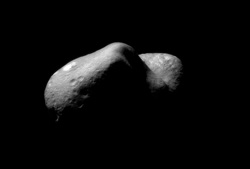
The Eros asteroid

The Eros asteroid. Photo credit: NASA

Scientists studying the dusty surfaces of asteroids have suggested that the force holding them together might be the very same van der Waals force that is responsible for interactions between atoms and molecules. Daniel Scheeres and his colleagues from the University of Colorado in the US, and Michael Swift from the University of Nottingham in the UK compared all the forces that might hold an asteroid together. The findings were published in the online preprint archive, arXiv.org.

The suggestion, reported in physicsworld.com might sound surprising, but the two potential forces that may act on the particles – gravity and the van der Waals force – behave in different ways. Gravity is proportional to the mass of the particles, where as the van der Waals force changes according to the surface area. Based on their study, the researchers concluded that gravity was not effective in binding the rocks observed in smaller asteroids.

Physicists may have discovered a new phase of liquid hydrogen

Scientists conducting simulations of the molecular-to-atomic transition in liquid hydrogen have found evidence for a previously unknown liquid phase. Isaac Tamblyn from Dalhousie University in Halifax, Canada along with Stanimir A. Bonev also observed some intriguing structural characteristics of liquid hydrogen.

Tamblyn told PhysOrg.com about the simulation, and how it was conducted. They discovered the reasons behind certain characteristics of hydrogen, such as the fact that liquid hydrogen is denser than solid hydrogen. The research and the information obtained, presented in Physical Review Letters, suggest that physicists might have to revise equations of the properties of hydrogen as well as change the planetary models that we currently use.

One step closer to quantum computing

Physicists at the University of Wisconsin-Madison in the US have successfully created a circuit using two rubidium atoms, in an experiment that demonstrates the possibility of using atoms to build quantum computers.

Professors Mark Saffman and Thad Walker were able to take advantage of a seven-millionths-of-a-second window to build a controlled-NOT (C-NOT) gate, a circuit important for quantum computing. The significance of the experiment lies in the use of neutral atoms instead of charged ions that had been used previously. Since atoms do not normally interact with each other as ions do, more of them can be arranged together in a small region. Read the original report on PhysOrg.com.

Strange fluctuating magnetic waves detected in superconductors
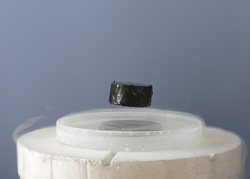
A magnet seen levitating over a superconductor cooled with liquid nitrogen.

The Meissner effect: a magnet levitating over a superconductor. Photo credit: Mai-Linh Doan

Researchers at Brown University in the US and others in France have studied for the first time what happens to electrons of a superconductor that are subjected to a magnetic field. Vesna Mitrovic and colleagues found that electrons in a superconducting material form strange, fluctuating magnetic waves under certain conditions.

It has been known for many years that there exists a relationship between magnetism and superconductivity (see image of Meissner effect), but the reason behind this relationship continued to baffle scientists. The research, mentioned in Science Daily, found that electrons in the superconducting material were tilted at various angles on their imaginary axes, and moved in a repeating pattern resembling waves. Most interestingly, the waves appeared to fluctuate under certain conditions. The scientists now hope to study why these fluctuations occur.

New material may revolutionise all-optical switching and computing

Scientists at Georgia Tech in the US have demonstrated a new class of material using molecules that could help develop all-optical switching devices. These devices would not require the signals to be converted from optical to electrical, then back again. These devices are essential for developing low-power, high-speed communications and computing.

Professors Seth Marder and Joseph Perry told PhysOrg.com about their work, which was reported in the 18 February edition of Science Express.

Cold-welding of gold and silver nanowires observed
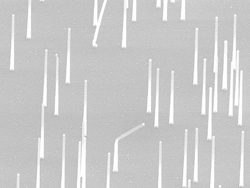
Gold nanowires

Gold nanowires, seen under a Scanning Electron Microscope. Photo credit: Thomas Mårtensson/Kristian Mølhave

Scientists at Rice University in the US have observed cold welding at the nano-scale for the first time. Jun Lou and his team came across this phenomenon by accident, when they were studying the tensile strength of gold nanowires.

The results, reported in Nature Nanotechnology, show that gold and silver nanowires of a thickness between three-billionths and ten-billionths of a metre bond with one another without the application of heat and without a loss of their electrical or mechanical properties. The welded wires never broke at the same spot when the researchers tried to pull them apart, proving the strength of the bonds. Read the original article here.

Crystal tech could give us 3D displays

Researchers at the National University of Singapore have developed a method of controlling the growth of certain crystals that have useful optical properties. Xiaogang Liu and his colleagues used a process called doping where certain “impurities” are intentionally added to a substance for the favourable properties it lends. They successfully used elements from the lanthanide group to dope the crystal, allowing them to adjust the structure, size and light emission spectra of the crystals.

Because of its interesting optical properties, scientists believe that these crystals could be used to develop 3D displays. The discovery was published in Nature and was reported in physicsworld.com.

By Ian Randall

Diamonds could be your computer’s best friend

Scientists have created a diamond nanowire that emits single photons, Nature Nanotechnology reported this week. Harvard University , the University of Munich and Texas A&M teamed up to use impurities within the crystal to generate light.

Lead researcher, Marko Loncar, said: “The diamond nanowire device acts as a nanoscale antenna that funnels the emission of single photons from the embedded colour center into a microscope lens.”

It is possible that, in the future, this technology might be applicable to the further development of fiber-optics in the fields of communication and computing.


Warming seas are melting Greenland glaciers

The ocean waters that melt ice in fjords significantly affect the stability of the edges of the Greenland ice sheet, Nature Geoscience reported this week. The research also showed that the submarine melting of glaciers can produce ice loss in the same order of magnitude as the breaking-off of icebergs.

“The studies by Straneo and Rignot and their colleagues are vital steps towards an understanding of Greenland’s ice loss into fjords,” commented Paul Holland, of the British Antarctic Survey.

The researchers carried out oceanographic studies of the fjord in which the sea meets the Helheim Glacier – where there is a notable interchange between the waters of the fjord and subtropical waters on the shelf.


Got milk?

Small herds of cows which are tied into stalls produce more milk than their counterparts that are allowed to roam free, it was announced this week. Researchers from the Norwegian School of Veterinary Science studied 812 herds of Norwegian Red Cattle in both tie- and free-stalls.

Lead author, Egil Simensen, said: “Free-stall cows in smaller herds produced significantly less milk than those in tie-stalls, but more milk in larger herds.”

The study, printed in the journal Acta Veterinaria Scandinavica, also showed that free-stall cattle are less susceptible to metabolic disease and have higher levels of reproductive success. This study follows a ban on the manufacture of new tie-stalls in Norway in 2004.

US scientists create universal afterbirth

Colliding gold ions, travelling near the speed of light, have created a liquid which is 250,000 times hotter than the Sun, reported Physical Review Letters this week. The material, a flowing mix of the subatomic particles quarks and gluons, was generated at the Brookhaven National Laboratory in New York.

Dr. William F. Brinkman, Director of the Department of Energy’s Office of Science, said: “This research offers significant insight into the fundamental structure of matter and the early universe, highlighting the merits of long-term investment in large-scale, basic research programs at our national laboratories.”

A 2.4 mile-circumference Relativistic Heavy Ion Collider was used to create the quark-gluon plasma – the same substance believed to have existed microseconds after the Big Bang, from which all other mater was formed.

By Joseph Milton

Welcome, and thanks for visiting Elements, a brand spanking new web site dedicated to covering the rapidly evolving world of science and technology.

There’s never been a more exciting time to be doing, writing about, or indeed reading about science and tech.

We are close to receiving results from CERN which could change physics forever, close to seeing synthetic life created from scratch in a lab, close to having unprecedented views of the universe through powerful new telescopes, and the influence of personal technology has never been greater in our lives. We also have to work out what we do next to reduce carbon emissions after the disappointment that was COP15.

As science journalists we hope to provide independent critical coverage of the hottest topics in science, as well as areas that interest us personally.

At Elements we have twenty young (at heart), talented and enthusiastic contributors. We’re from a wide range of backgrounds, spanning the arts through academic science to medicine. We also have a variety of interests from geology to health, so the site will include a diverse selection of topics and styles.

As the editor of the website, I’ll be keeping you up to date with what’s going on here at Elements in regular posts. So, once again, welcome. We hope you enjoy the site,

Joe Milton