By Laura Husband

Astronauts may have problems with immune deficiencies while in space, a new study has found.

The study carried out at the University of Arizona in the US with mice found that weightlessness during spaceflight caused changes to genes that controlled an immune and stress response.

“Our results hint at the possibility that an astronaut’s immune system might be compromised in space,” said immunobiologist and lead researcher Ty Lesback.

Weightlessness during spaceflight causes a change to the immune system that can make astronauts ill. Image credit: NASA

The thymus gland, which plays a key part in the immune system, was compared in four mice who spent 13 days in a space shuttle with four mice who remained on the ground.

All four mice that spent time in space were found to have changes in the same 12 genes within the thymus tissue.

“The altered genes we observed were found to primarily affect signaling molecules that play roles in programmed cell death and regulate how the body responds to stress,” explained Lesback.

Programmed cell death has an important function. But cell death needs to be tightly regulated in the immune system for the process to run smoothly.

“Potentially you could get more cell death aboard a spacecraft because many of the gene changes resulted in down-regulated changes that are needed to maintain the balance,” said Lesback.

The activity levels of thousands of genes in thymus tissue from the space-flown mice and the control group had to be compared and analysed.

By Achintya Rao

Observations of a cluster of galaxies not too far from home have revealed that the cannibalistic galaxy at the centre of the cluster might be the most massive one in our local universe.

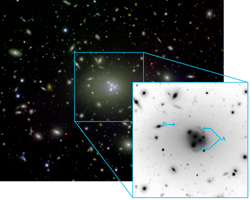
Images of Abell 3827 from the Gemini Observatory

Images of Abell 3827 from the Gemini Observatory. Gemini Legacy Image: R. Carrasco et al., Gemini Observatory/AURA

The galaxy ESO 146-IG 005 at the centre of the galaxy cluster Abell 3827 has been known for over a decade to be cannibalistic, but astronomer Rodrigo Carrasco says, “The magnitude of its appetite has not been fully appreciated.” Carrasco and his colleagues at the Gemini Observatory‘s South telescope in Chile used the recent discovery of the gravitational lens around the cluster to conclude that the galaxy is nearly 30 trillion times the mass of Sol, our sun.

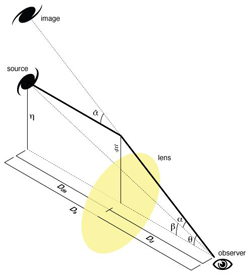
Line diagram of light bending around a mass

Line diagram of light bending around a mass. Image credit: Michael Sachs

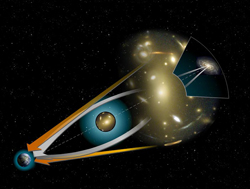
Gravitational lensing is observed when light from a distant star or galaxy bends around a closer star or galaxy, sometimes giving the illusion of being in more than once place at a time. Often, the image of the star or galaxy observed will appear elongated. The bending of light is caused by the distortion of local spacetime by a massive object (see images). These apparent images sometimes form what are called Einstein’s rings.

The gravitational lens around the cluster, located 1.4 billion light years away from us, gave astronomers a value for the mass of the central galaxy that was 10 times higher than estimates using X-rays. “Assuming our model is correct, this is by far the most massive galaxy known in our local universe,” Carrasco said.

The two background galaxies observed lie at distances of 2.7 billion light years (labelled A, in the first image) and 5.1 billion light years (labelled B) away from us.

How Einstein's rings are formed

How Einstein's rings are formed. Image credit: NASA

The results, to be published in The Astrophysical Journal Letters1, are very important, particularly to understand the growth of elliptical galaxies. These galaxies are thought to acquire most of their mass by merging with other galaxies or by consuming them over the course of time. Cannibalistic galaxies such as ESO 146-IG 005 can grow to tremendous sizes by consuming their neighbours.

Michael West, an astronomer from the European Southern Observatory, who first observed the cannibalistic behaviour in 1998, said, “This unabashed cannibal is something of a messy eater, with the partially digested remains of at least four smaller galaxies still visible near its centre. Eventually this galaxy will grow even bigger judging by the number of nearby galaxies already within its gravitational grasp.”

  1. E. R. Carrasco, P. L. Gomez, T. Verdugo, H. Lee, R. Diaz, M. Bergmann, J. E. H. Turner, B. W. Miller, & M. J. West (2010). Strong Gravitational Lensing by the Super-massive cD Galaxy in Abell
    3827 The Astrophysical Journal Letters arXiv: 1004.5410v1 []

By Tushna Commissariat

Astronomy and astrophysics has has advanced in leaps and bounds over the past few decades. As mankind attempts to foray further into the universe, it’s the little things that get by us sometimes.

Star formation is an area that has been well researched and studied and though we understand the ‘how’ and the ‘why’ of stellar genesis and evolution; it is very difficult to get visual evidence for theoretical data.

Images of Orion Nebula - a star forming area - taken by Plank... Image credit: ESA, LFI and HFI Consortia

In our home galaxy, the Milky Way, there are an expected 100-400 billion stars. But weaving through this mass of stars are vast clouds of gas and dust that are generally referred to as the interstellar medium (ISM).

Now as much as the ISM might sound like a really cool name for dirt in space right out of Star Trek, it’s this very dust that obscures our views of new-born stars in visible light.

If we tune our instruments to look with longer wavelengths, especially where the Cosmic Microwave Background can be penetrated, lo and behold, a much clearer picture awaits us!

The dust no longer blocks the emission from the innermost regions of the galaxy and details previously unseen are revealed. New images from ESA ‘s Planck mission have revealed precisely this, isolating actual physical processes at work.

... and by Digitised Sky Survey of the same area in visible wavelength. Image credit: STScI DSS

How does Planck mapping work?

Planck maps the sky in nine frequencies using two state-of-the-art instruments, designed to produce high-sensitivity, multi-frequency measurements of the diffuse sky radiation: the High Frequency Instrument (HFI) includes the frequency bands 100 – 857 GHz, and the Low Frequency Instrument (LFI) includes the frequency bands 30-70 GHz.

The first Planck all-sky survey began in August 2009 and will be completed by late-May 2010. Planck will gather data until the end of 2012, by which time it should complete four sky scans.

At the lowest frequencies, Planck notes emissions that occur due to relativistic electrons moving at relativistic speeds that interact with the Galactic magnetic fields (also known as synchrotron emissions), and that of free-free emission arising from electrons interacting with hot gas (they are called ‘free-free’ emissions as the electrons remain free even after they cause emission of a photon.).

At intermediate frequencies (corresponding to wavelengths of a few millimetres), the emission are mainly thermal emission of ionised gas heated by newly-formed hot stars.

At the highest frequencies, Planck maps the distribution of interstellar dust, including the coldest compact cores in the final stages of collapse towards the formation of new stars.

A star is made

Once stars are formed, they disperse the surrounding molecular clouds. An equilibrium between cloud collapse and dispersion regulates the number of stars that any given galaxy makes.

Various other physical phenomena influence this balance, including gravity, heating and cooling, turbulence, magnetic fields and more.

As a result of this interplay, the ISM rearranges itself into ‘phases’ which coexist side-by-side; so the molecular clouds that contain dense and cool gas and dust and the ‘cirrus’ containing more diffuse and warmer material.

The only way to accurately have data on the phases and constitutional elements of the ISM is to look at it through multiple frequencies; something that Plank can do.

As Plank can study all the mechanisms simultaneously, we can get data of all processes at the same time which is very beneficial. Also as it maps different areas; we can compare the difference seen in the ISM in a star forming area, such as the Orion Nebula with that seen in a low star formation area.

Recent images from Plank have shown us just that. For more information on the planck mission as we as star formation please visit the ESA Planck homepage.

By Tushna Commissariat

The illustrious Hubble Space Telescope (HST) recently celebrated its 20th anniversary, bringing to light one of the most celebrated and accomplished man-made scientific instruments. On April 24 this year, the HST officially completed 20 years in orbit, making it the most successful venture that NASA and the ESA have embarked upon.

The iconic Hubble image: the Pillars of Creation. Image credit: NASA, ESA, M. Livio and the Hubble 20th Anniversary Team (STScI)

On 24 April 1990, the Space Shuttle and crew of STS-31 launched the NASA/ESA Hubble Space Telescope into a low-Earth orbit. What followed was an epic era of the HST collecting some of the most fantastic images ever seen of the entire universe. Its many discoveries have aided and abetted astronomy, astrophysics and cosmology over the years, giving us visual proof for many things that were merely theoretical in the past. It wasn’t always a smooth curve, with the primary mirror being out of focus within a few weeks from launch, broken equipment, and a Space Shuttle rescue/repair mission that was cancelled. There was even talk of not reparing equipment a few times but the Hubble team of engineers, scientists and astronauts from NASA and ESA both proved time and time again that the HST had a lot more to give. To date, Hubble has looked at over 30,000 celestial objects. Its vast archives include over half a million pictures. The most recent renovation was carried out in May 2009, making the telescope 100 times more powerful than when it was launched.

Image celebrating HST 20th Anniversary: Image of the Carina Nebula. Image credit: NASA, ESA, M. Livio and the Hubble 20th Anniversary Team (STScI)

As a part of the celebrations, NASA, ESA and the Space Telescope Science Institute (STScI) decided on commemorating the date with a stunning new image. The Hubble anniversary image highlights a small portion of one of the largest observable regions of starbirth in the Galaxy, the Carina Nebula. Towers of cool hydrogen interwoven with dust ascend from the wall of the nebula. The scene is rather evocative of Hubble’s 1995 iconic image - “Pillars of Creation” taken by Jeff Hester and Paul Scowen .This image captures the top of a pillar of gas and dust, three light-years tall, which is being eaten away by the brilliant light from nearby bright stars. The pillar is also being pushed apart from within, as infant stars buried inside it fire off jets of gas that can be seen streaming from towering peaks like arrows sailing through the air.

Another very interesting aspect of the celebration is the Hubble Pop Culture contest, being conducted by the spanking new European website for HST. It calls to people from all over the world who have enjoyed Hubble images over the years to search for the images that have made their way into culture and arts, as seen in everyday life.

Further shots of the Carina Nebula; details of the 'Cosmic Pinnacle' shown. Image credit: NASA, ESA, M. Livio and the Hubble 20th Anniversary Team (STScI)

Also, Hubble fans can post a Facebook message or use the Twitter hashtag #hst20 or get onto the Hubble website and go to the “Messages to Hubble” page. There they can add their own messages or read selections from other messages. Fan messages will be stored in the Hubble data archive along with the telescope’s many terabytes of science data. The Hubble team hope to show future scientists just how much the telescope impacted our world and showed us, with extreme clarity, the awesome beauty of our universe.

By Paul Rodgers

One of the Milky Way’s closest neighbours just became a bit clearer thanks to an infrared image taken by the European Southern Observatory.

The Messier 83 galaxy, seen in infrared for the first time, reveals its hidden structure and hordes of previously obscured stars.

Messier 83, also known as the Southern Pinwheel Galaxy, just 15 million light years away in the Hydra (Sea Serpent) constellation, is 40,000 light years wide, about 40 per cent the size of our home galaxy.

But despite it’s closeness, much of its internal structure and many of its stars were obscured by clouds of dust.

But most dust becomes transparent at infrared frequencies, allowing astronomers to get a better look at it with the Hawk-I (High-Acuity Wide-field K-band Imager) instrument at the Very Large Telescope (VLT) in the Paranal Observatory in Chile. The Paranal Observatory is run by the ESO, which includes the UK. Brightly lit gas surrounding hot young stars in the galaxy’s spiral arms also fades in infrared pictures.

This clear view is important for astronomers looking for clusters of young stars, especially those hidden in dusty regions of the galaxy, one of the main objectives of the latest observation.

Messier 83 is one of the brightest, if blurrier, galaxies, and can be seen using binoculars. It is famous for sharing the record for having the most supernovae – six stars exploded there in the past century.

It was discovered from the Cape of Good Hope in South Africa by Pierre Mechain discovered in 1752 but was named after Charles Messier who added it to his catalogue of nebulous objects in 1781.

The VLT’s huge mirror, its large field of view and sensitivity combined with the good observing conditions at ESO’s Paranal Observatory makes Hawk-I, which began operation in 2007, one of the most powerful, and sought after, near-infrared imagers in the world.

By Tiffany Stecker

One week before the delay of the Cryosat-2 mission launch, Tiffany Stecker interviews Duncan Wingham, lead scientist of the mission and researcher at University College London’s Center for Polar Observation and Modelling (CPOM). Dr. Wingham discusses why a satellite like CryoSat-2 is important for studying polar ice sheets and ocean levels, the cost of launching the satellite and what this means in a time of growing doubt over climate research.

By Joseph Milton

That’s not fair

Overt inequality is distasteful to most of us and social scientists have long suggested that humans dislike perceived unfairness, based on behavioural and anthropological evidence. Now, for the first time, research published in Nature shows that neurons - brain cells- involved in the brain’s reward circuitry directly respond to the fairness of a situation.

John O’Doherty’s team at the California Institute of Technology monitored neural responses in the striatum and prefrontal cortex of participants who were paired up to take part in a monetary game.
One participant in each pair was given more money than the other. Both were aware of the disparity.

The team then selectively handed out more money, and found that neuronal activity was greater in the ‘high-pay’ people when money was given to the ‘low-pay’ person rather than to themselves. The opposite pattern of activity was seen in the low-pay participants.

Scent hormone vital for bonding identified

A key hormone which allows animals to form bonds with others through smell has been identified by researchers at The University of Edinburgh.

Vasopressin helps the brain differentiate between familiar and new scents, allowing animals to establish strong bonds. Many scientists think a failure in this recognition system in humans may prevent people from developing deep emotional bonds with others. A lack of scent based bonding could be at the root of conditions in humans such as some forms of autism and social phobia.

The study, published in the journal Nature, suggests that when the hormone fails to function, animals are unable to recognise other individuals from their scent.

The researchers reached their conclusion by studying rats. They placed an adult rat in an enclosure with a baby rat and left them to sniff each other.

After a short separation, they placed the baby back in the adult’s enclosure, together with an unknown baby. Adult rats which lacked vasopressin failed to recognise the familiar baby.

Google take-away

In the wake of Google’s spat with the Chinese government, Nature’s news team surveyed scientists in China to find out how much they rely on Google – and what the consequences would be if they lost access to the search engine.

More than three-quarters of the scientists quizzed said they use Google as the primary search engine for their research. Over 80 per cent use the search engine to find academic papers; close to 60 per cent use it to get information about scientific discoveries or other scientists’ research programmes; and more than half use the literature search Google Scholar.

Eighty four per cent of the scientists who responded to Nature’s survey said their research would be “somewhat or significantly” hampered by losing access to Google and 78 per cent said that international collaborations would be affected to the same degree.

One Chinese scientist said: “Research without Google would be like life without electricity.”

The full survey results are online at www.go.nature.com/FJ6QTm

Gas-giant losing atmosphere to star

A recently discovered extrasolar planet is losing its atmosphere to its host star, according to a paper published in Nature this week.
A team at Peking University in Beijing analysed WASP-12b, a gas-giant planet larger than Jupiter. The planet is orbiting very close to its star, and has a surprisingly large radius. Although WASP-12b is strongly heated by its host star, this energy source is not sufficient to explain the planet’s inflated size.

The team, led by Shu-lin Li, suggest that WASP-12b’s close orbit subjects it to extremely large tidal forces. These forces are spread throughout the body of the planet, providing an energy source for the planet’s large volume. The authors infer that WASP-12b’s atmosphere is escaping the planet’s gravitational field, and flowing towards the host star.

Clipping the wings of dengue and malaria

An estimated 50–100 million new dengue fever infections occur each year in tropical countries, and improved control of the mosquito species which carries the disease could save many lives.

Now a team of scientists have developed genetically modified strains of Aedes aegypti, the mosquito which carries dengue. The modified male mosquitoes carry a gene which interferes with wing growth.

Research led by Guoliang Fu of the University of Oxford, and published in the Proceedings of the National Academy of Sciences (PNAS), suggests releasing the GM male mosquitoes to mate with females. The resulting female offspring would then be born with the gene limiting wing growth.

The team estimates the new breed could sustainably suppress the native mosquito population in six to nine months.

The same technique could be used in the future to tackle mosquitoes that spread malaria.
By Tushna Commissariat

Astronomers and star gazers rejoice! The International Dark Sky Association (IDA) declared Galloway Forest Park as the first Dark Sky Park in the UK on Monday 16 November 2009. The announcement, made during the International Year of Astronomy, is a great achievement as a result of 15 months of planning and coordinating audits, controls and readings from the forest park and nearby areas in a bid to boost tourism in south west Scotland.

A clear view of the sky. Picture credit: NASA

The final decision was made by the IDA, a non-governmental organisation (NGO) based in Arizona, USA. Lighting experts were brought in to make sure the standards for the IDA’s highest honor- the gold tier Dark Sky Park status - were maintained.

This requires a rating process for the sky quality meter which is best describes as a measure of the darkness of the sky in different areas worldwide.The scale extends from 0 to 25 and various locations have different readings; with the highest reading for the darkest place. For example, anywhere close to a major city would have a reading of around eight units while even a smaller town would be about 15 or 16 units on the scale. A photographer’s dark room would be 24 units. The reading for Galloway Park is 21 to 23.6 units overall, coming as close as possible to complete darkness near civilization of any sort.

Galloway Forest Park was established in 1947 on 75,000 hectares of land. It has 10 official viewing sites that are always open to the public from April to October and can be reached by foot, bike or horse. For other vehicles there is controlled access except for the two forest drives.

According to the Forestry Commission the park has 850,000 visitors each year and hopes to double the number with their new status. It is now the best place in the world for stargazing with over 7000 visible stars and views of the Milky Way and our own galaxy, which statistics show that less than 10% of people in the UK can view from their own homes. The forest also houses the Wigtownshire Astronomical Society observatory which always welcomes visitors.

By Jenn Green

The chance of detecting extra terrestrial life is now greater than ever before, Lord Martin Rees told scientists two weeks ago at a Royal Society conference in London. The meeting discussed current developments in the search for alien life and its consequences for science and society.

Lord Rees, President of the society, claims that with new technology it will now be possible to detect earth-like planets orbiting other stars, focusing the search for extra terrestrials.

“Were we to find life, even the simplest life, elsewhere that would clearly be one of the great discoveries of the 21st Century”, he said.

He told the audience that if life was discovered in outer space he suspected it would be in intelligent forms that we would not be able to conceive.

“There could be forms of intelligence beyond human capacity, beyond as much as we are beyond a chimpanzee”, he said.

However Dr Lewis Dartnell, astrobiologist and author of the book ‘Life in the Universe’, thought that the difference between humans and aliens could be starker than this, as intelligent life would have evolved somewhere in the galaxy over the last four or five billion years.

“It would not even be the comparison between chimpanzees and humans, it would be between humans and something we possibly could not even conceive, and maybe will not even be able to recognise.”

“If we come across an intelligent species they would appear like Gods to us,” explains Dartnell. “They would have such advanced technology we would not be able to distinguish it from magic.”

By Tiffany Stecker

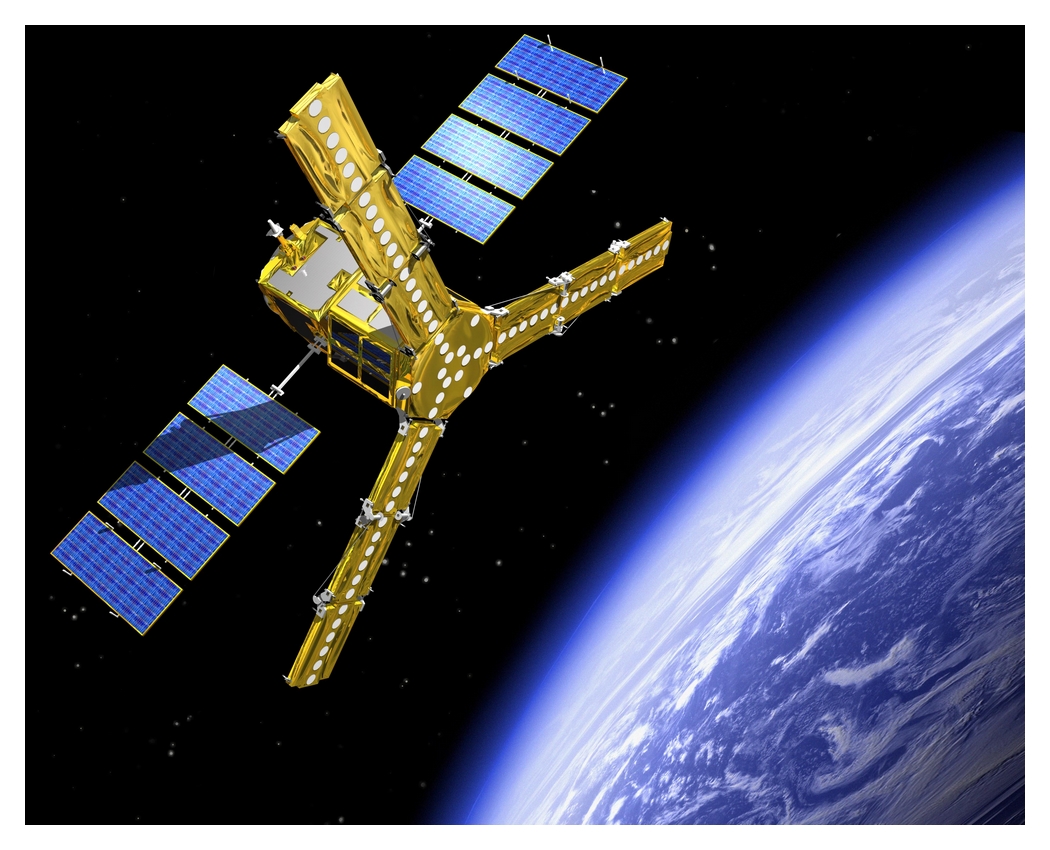
The European Space Agency (ESA) has launched the first-ever satellite to gauge soil moisture and ocean salinity, with the mission of collecting crucial data on atmospheric and terrestrial water to provide more accurate weather forecasting.

The Soil Moisture and Ocean Salinity (SMOS) satellite was launched in early November from northern Russia. It is the second of six satellites the ESA have launched in their Earth Explorer Mission, which aims to track changes in the earth’s resources more efficiently.

SMOS

The launch of the SMOS is a timely one. The mission began just days after torrential floods fell upon Scotland and Wales. Floods, as well as droughts, are two phenomena scientists hope to understand better from the data. Soil moisture can give an insight as to whether water runs off soil or absorbs into it.

“This touches on two very important aspects of the water cycle,” said Mark Drinkwater, head of the Mission Science Division of the ESA. “We have very little knowledge today on how water exchanges with the atmosphere.”

The satellite measures radioactivity in microwaves called L Band, waves approximately 20 cm long. It is the first L Band radiometre in space.

Using these waves, the satellite will measure moisture levels in the upper layer of soil, ocean salinity and evaporation rates. It is designed to track miniscule changes in moisture and salt concentration and consequently, how storms develop and how soils react to excessive amounts of water.

According to Drinkwater, SMOS can detect levels of moisture equivalent to a teaspoonful of water in a handful of soil. The satellite will be able to measure dampening and drying cycles of the soil in response to rainfall events every three days.

“It gives a global view on the distribution of soil moisture,” said Yann Kerr, lead investigator with the Center for Spatial Studies of the Biosphere. “There is no measurement of soil moisture in [current] weather forecast models.”

A major indicator of flood magnitude is not necessarily the amount of rainfall, said Kerr, but the ability for soil to absorb it.

“You can have dry soil with heavy rain, and there won’t be flooding,” he said, “Or you can have drenched soil and little rain and there is a flood.”

For example, floods in France earlier this year were linked to waterlogged soils, rather than heavy rain.

The satellite must undergo a six-month commissioning phase before it can engage in a longer program. It is guaranteed for three years, with a life expectancy of five, said Kerr.

SMOS will also measure water salinity, which indicates ocean current movement and can estimate how and at what rate climate will change. The satellite can measure salinity with an accuracy of 0.01 to 0.02 per cent, and has the sensitivity to detect a “small pinch of salt in a litre of water,” said Drinkwater. The team will accumulate global ocean data over longer intervals than soil moisture, in order to map changes throughout the year, and examine how patterns of surface salinity vary seasonally.

The European Centre for Medium-Range Weather Forecasts will be one of the primary users of this data. The centre predicts weather patterns across Europe and expects forecasts to become more accurate with the help of SMOS.

“What is important for us is the construction of a model between atmospheric variables and surface values of soil temperature,” said Patricia de Rosnay, a scientist at the centre.

Yet de Rosnay is aware that it is early days for SMOS, and the level of importance and reliability of the soil humidity and salinity data is yet to be known.

“We will wait and see how much it improves the forecast. The Earth Explorer mission is a new concept, and it is the first time we have soil moisture information,” she said. “In 2010, we will see how useful it is.”

The next satellite in the Earth Explorer series will be Cryosat, which will measure changes in ice formations.