Aleksey Gurkin

Journalism training in Kyrgyzstan is entirely based on Russian universities’ programmes and is outdated both in content and technically, said Aleksey Gurkin, chair of journalism and mass communications department at the American University in Central Asia (AUCA).

“In most cases the curriculum that is being used here is largely based on the curriculum being used in Russian universities. In the best scenario it will be the Moscow State University, and in the worst one of those peripheral universities in Russia. The problem is that the Russian style of journalism is very specific. And the people who develop curriculums are those who are followers of this specific model of journalism,” said Gurkin. “A lot of materials and the way of teaching itself are outdated, because substantial resources are required to update the programmes continuously. And in our case we don’t have even our own learning materials”.

The main problem with using the Russian curriculum and learning materials is that nobody tries to adapt them to local needs and even understand what is really needed. “We basically take Russian programmes and transplant them here, which is not always the best option. The best practices come from other countries and in this case it is Russia; however they need to be adapted to local needs and this is something that is missing. It plays a negative role in terms of how in tune we are with contemporary developments in the media world,” added Gurkin.

According to Gurkin, Kyrgyz journalism still contains a lot of details borrowed from the Soviet school of journalism because it mostly copies the Russian way of doing journalism. “It is not appropriate at all. We are lagging behind current tendencies of journalism”.

In AUCA teachers use an interdisciplinary approach; however they have to struggle with the Kyrgyz Ministry of Education which condemns them for not complying with state standards. As AUCA uses an American style of teaching journalism as opposed to state standards based on a Russian one, there is a reason for conflict.

“We believe we are preparing students who are more adaptable to a modern media environment and a modern journalism profession”, said Gurkin.

Lack of technical resources is another problem which affects the journalism teaching process. If, for example, students are interested in broadcast journalism they often have no opportunity to practice gained skills using modern video, editing or sound equipment. “They often end up applying for jobs in the local TV channels and start to use equipment they have just seen for the first time in their lives,” added Gurkin.

The lack of younger professionals also is a big issue for journalism departments in Kyrgyzstan. In the Kyrgyz National University, most of the teachers used to be journalists in the Soviet Times, more than 20 years ago. It affects enormously the quality of education, according to Gurkin.

“When something happens in Kyrgyzstan foreign journalists come here and do things themselves rather than working with local journalists or commissioning to them to produce something. That is not because most of them don’t speak English or that some of them cannot produce material up to standard to be published by the foreign media. It is because they simply have no contacts abroad and are very local-oriented,” said Gurkin.

Aleksey Gurkin also said how prestigious and popular among potential students the journalism profession is. If you are interested please listen to his short interview below.

Aleksey Gurkin audio

By Smitha Peter

Recent studies by Natural England and the European Red List reveal that biodiversity is facing serious threats due to loss of habitat.

According to the first study, 480 of the 492 observed species have gone extinct in the past two centuries. The second one says that almost one-third of butterfly species are in decline. Both reports view industrial agriculture as a major factor, along with hunting, pollution and climate change.

Golden eagle - one of the lost species

Golden eagle - one of the lost species. Image credit: J. Glover - Atlanta, Georgia

“Mixed farming or rotational farming is the way forward. Diversity is both a measure of increasing production and conservation of nature,” said environmentalist Dr Vandana Shiva in her speech ‘Perils of the industrial agricultural system’ at the Gaia Foundation in London.

She added that small-scale farming is the most sustainable way for agricultural production.
The European Red List report suggests that the shift from traditional farming methods have especially hit insect species like butterflies. “New agricultural techniques provide little or no space for wild plants and flowers to grow. Moreover, it is based on monoculture, where the plant varieties cultivated are often not butterfly friendly,” says Malcolm Bridge from Butterfly Conservation.

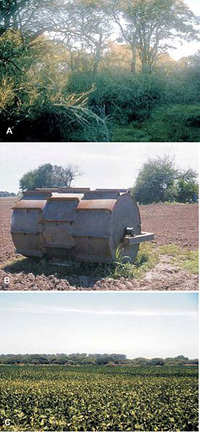
Forest cleared for soybean cultivation

Forest cleared for soybean cultivation. Image credit: Marcelo R. Zak

A study by the Centre for Ecology and Hydrology (CEH) on soil organisms also had interesting results. It stated that although the number of soil bugs increased by 47 per cent in the past 10 years, diversity of bugs has decreased by 11 per cent.

However, scientists warn that further research is needed to be sure of the trend, as the effect of land management, pollution and climate change on soil bugs is not clearly known. The study also observed that there is no significant increase in the number of bugs in arable land, probably due to the regular disruption of their habitat. Diversity of organisms helps the soil cope with pollution and changing weather conditions.

Industrial agriculture is designed to obtain maximum output from minimum input by utilising technological advancements. Production of cheap and plentiful food is viewed as its main benefit.

Audio clip: Adobe Flash Player (version 9 or above) is required to play this audio clip. Download the latest version here. You also need to have JavaScript enabled in your browser.

By Jennifer Green and Julius Goldthorpe

Japanese Knotweed causes millions of pounds worth of damage to buildings and roads in Britain every year. If attempted, eradicating the weed using traditional methods would cost around £1.5 billion pounds. But scientists have Cab International think they have come up with a natural solution, a tiny psyllid from Japan. The bug, set to be released here this year, will be the first live agent introduced in Europe to control a weed…

By Smitha Peter

Additives are used to improve the appearance and odour of processed food items. They also enhance shelf lives. Such additives include acids, antioxidants, flavour enhancers, preservatives and sweeteners. Their use has significantly increased alongside the popularity of processed produce in the past two centuries.

Food additives are often used to improve the taste and appearence of processed foods. Image credit: Valerio Capello

There has been significant controversy associated with the risk and benefits of additives. In this piece, Prof. Martin Caraher, of City University London’s Centre for Food Policy, express his views about food additives.

Audio clip: Adobe Flash Player (version 9 or above) is required to play this audio clip. Download the latest version here. You also need to have JavaScript enabled in your browser.

By Charlotte King and Laura Husband

Climate change and the environment did not feature highly in the General Election, with the economy taking centre stage. But at least some of the public must feel concerned about the environment, having voted in the first green MP in British Political history, leader of the Green Party, Caroline Lucas.

Simon and Ed did not agree on a few things.

So what are the three main party’s views on the big issues of the environment and climate change today? Laura Husband and Charlotte King went to the Climate Change debate hosted by the Guardian a week before the General Election to find out: In order of appearance in the first piece of audio, here’s what Greg Clark from the Conservatives, Ed Miliband from the Labour Party and Simon Hughes from the Liberal Democrats had to say on some major climate change issues.

Expanding Heathrow

Expanding London’s Heathrow airport has been a hotly-contested issue. Labour’s general consensus has been ‘for’ the airport, the Liberal Democrats ‘against’ the airport and the Conservatives against but in favour of an airport elsewhere.

Audio clip: Adobe Flash Player (version 9 or above) is required to play this audio clip. Download the latest version here. You also need to have JavaScript enabled in your browser.

Will the Tory-Lib Dem alliance increase air travel to and from the UK? Picture credit: Axwel on Flickr

Climate Skeptics

A number of climate skeptics have spoken out against the existence of man made climate change following the controversial emails sent by a climate scientist from the University of East Anglia stating that some of the tree data was a ‘trick.’ There are also members of the three main parties who admit to being skeptical about climate change. So how do the three main parties deal with climate change skeptism?

Audio clip: Adobe Flash Player (version 9 or above) is required to play this audio clip. Download the latest version here. You also need to have JavaScript enabled in your browser.

Greg had to defend the Tories

Present climate change policy

Prior to the general election, Labour’s carbon emissions policy was to reach a 34 per cent reduction against 1990 levels by 2020. But did the other main parties think this was realistic or indeed enough?

Audio clip: Adobe Flash Player (version 9 or above) is required to play this audio clip. Download the latest version here. You also need to have JavaScript enabled in your browser.

Peak Oil

Peak oil is the point in time when there is no more petroleum in the ground to be extracted. There is uncertainty about when peak oil will be reached, what to do in the mean time and what to do when it is finally happens among the major parties.

Audio clip: Adobe Flash Player (version 9 or above) is required to play this audio clip. Download the latest version here. You also need to have JavaScript enabled in your browser.

Have we reached peak oil or is it yet to come? Image credit: Chad Teer

Commentator at the Guardian George Monbiot asks how we will reduce fossil fuel consumption, in particular oil.

Whether to use the UK’s entire quota of oil before it runs out or whether to save some of it is a dividing question among the major parties.

Audio clip: Adobe Flash Player (version 9 or above) is required to play this audio clip. Download the latest version here. You also need to have JavaScript enabled in your browser.

George Monbiot wrote the book 'Heat'. Image credit: JK the Unwise

Climate modeling

There is debate among scientists about how to measure climate change, and different models produce varying degrees of environmental change. A physicist questioned the model the politicians have been working with and suggests they should be using an alternative, which would be more accurate.

Audio clip: Adobe Flash Player (version 9 or above) is required to play this audio clip. Download the latest version here. You also need to have JavaScript enabled in your browser.

By Christine Ottery

Climate science has shown in the past six months that – and sorry if this is a climate change cliché – things are worse than we thought. According to the most up-to-date science, Clive Hamilton, author of Requiem for a Species: Why we resist the truth about climate change says that we are likely to see warming of 4 degrees by 2070 or 2080. Despite this, some recent climate change studies have not made a much of a splash, obfuscated in a fug of Climategate. Hamilton thinks there has been a campaign against climate scientists. You can read more about this in an extract of his book here.

Professor Clive Hamilton

Hamilton also examines the yawning gap between the public perception of climate change and the science. Why do people’s beliefs, and therefore actions, stray from the facts? At a talk at the RSA, Hamilton states that people fall into three groups: those that don’t accept manmade climate change, including denialists; those with maladaptive strategies, who accept the facts but can act as if they don’t exist; or people who are adaptive and behave in line with reality. Hamilton says most of us are maladaptive, so there are real question marks over how we are going to face the challenges of climate change.

I caught up with Hamilton after the debate to continue the discussion of how to get people to act on climate change.

Audio clip: Adobe Flash Player (version 9 or above) is required to play this audio clip. Download the latest version here. You also need to have JavaScript enabled in your browser.

[Credit: www.freesound.org/eraylik for Protest_Zara_Day, mw_1984 for rallyclap2, dobroide for 20070210.helicopter, medialint for Iraq_War_Demonstration_SanFrancisco, osivo for newspaper and ERH for by any means]

By Christine Ottery

Barefoot running a new trend in fitness. But is it actually better for you than running in traditional padded trainers? I spoke to some experts, including podiatrist Justin Coulter and sports scientist Lee Saxby to find out – once I’d got my breath back from trying barefoot-style running for myself.

Is it better for us to walk and run barefoot?

Audio clip: Adobe Flash Player (version 9 or above) is required to play this audio clip. Download the latest version here. You also need to have JavaScript enabled in your browser.

For more information see my feature on The Ecologist website.

By Achintya Rao

India sent a team of students to the International Sustainable World (Energy, Engineering and Environment) Project [I-SWEEEP] Olympiad for the first time this year. The Olympiad was held between 14 April and 19 April this year. I spoke to Dr Arnab Bhattacharya, co-chair of the IRIS Scientific Review Committee that selects and guides the students, to ask him about the experience.

Audio clip: Adobe Flash Player (version 9 or above) is required to play this audio clip. Download the latest version here. You also need to have JavaScript enabled in your browser.

I-SWEEEP

Image Credit: I-SWEEEP

by Joseph Milton

A polyp: a pre-cancerous growth in the bowel

A one-off five-minute procedure reduces deaths from bowel cancer by 43 per cent and decreases the incidence of the disease by a third.

If introduced nationally, it would save at least 3,000 lives every year, and save the National Health Service £28 for every person screened by removing the need for treatment, according to a study published in the Lancet.

Listen to Joseph Milton’s audio report below.

Audio clip: Adobe Flash Player (version 9 or above) is required to play this audio clip. Download the latest version here. You also need to have JavaScript enabled in your browser.

doi:10.1016/S0140-6736(10)60551-X

By Gulnura Toralieva

On 1 January, Kazakhstan became the first ex-Soviet state to chair the Organisation for Security and Co-operation in Europe, or OSCE. This is the world’s largest regional security organisation, and chairing it is a significant milestone in the country’s post-Communist history.

It is speculated that Kazakhstan will be able to increase the OSCE’s role in Central Asia and provide a forum to overcome regional problems. However Annette Bohr, associate fellow for the Russia and Eurasia Programme at Chatham House, argued that Kazakhstan has its own agenda. She spoke to Gulnura Toralieva about Kazakhstan’s role as the OSCE chair.

Annette Bohr. Photo credit: Chatham House

Audio clip: Adobe Flash Player (version 9 or above) is required to play this audio clip. Download the latest version here. You also need to have JavaScript enabled in your browser.