Smitha Peter

Since I like both science and writing, I have decided to go for science journalism. I would like to work on environmental related issues which are plenty in present times. However I have a special interest on the impact of genetically modified crops on biodiversity and third world economy.

By Smitha Peter

Recent studies by Natural England and the European Red List reveal that biodiversity is facing serious threats due to loss of habitat.

According to the first study, 480 of the 492 observed species have gone extinct in the past two centuries. The second one says that almost one-third of butterfly species are in decline. Both reports view industrial agriculture as a major factor, along with hunting, pollution and climate change.

Golden eagle - one of the lost species

Golden eagle - one of the lost species. Image credit: J. Glover - Atlanta, Georgia

“Mixed farming or rotational farming is the way forward. Diversity is both a measure of increasing production and conservation of nature,” said environmentalist Dr Vandana Shiva in her speech ‘Perils of the industrial agricultural system’ at the Gaia Foundation in London.

She added that small-scale farming is the most sustainable way for agricultural production.
The European Red List report suggests that the shift from traditional farming methods have especially hit insect species like butterflies. “New agricultural techniques provide little or no space for wild plants and flowers to grow. Moreover, it is based on monoculture, where the plant varieties cultivated are often not butterfly friendly,” says Malcolm Bridge from Butterfly Conservation.
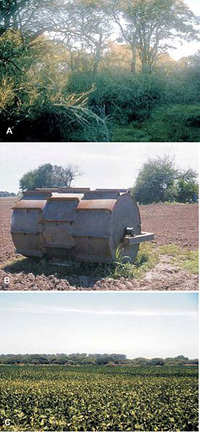
Forest cleared for soybean cultivation

Forest cleared for soybean cultivation. Image credit: Marcelo R. Zak

A study by the Centre for Ecology and Hydrology (CEH) on soil organisms also had interesting results. It stated that although the number of soil bugs increased by 47 per cent in the past 10 years, diversity of bugs has decreased by 11 per cent.

However, scientists warn that further research is needed to be sure of the trend, as the effect of land management, pollution and climate change on soil bugs is not clearly known. The study also observed that there is no significant increase in the number of bugs in arable land, probably due to the regular disruption of their habitat. Diversity of organisms helps the soil cope with pollution and changing weather conditions.

Industrial agriculture is designed to obtain maximum output from minimum input by utilising technological advancements. Production of cheap and plentiful food is viewed as its main benefit.

Audio clip: Adobe Flash Player (version 9 or above) is required to play this audio clip. Download the latest version here. You also need to have JavaScript enabled in your browser.


By Smitha Peter

According to United Nations Convention, every child has a right to not to go hungry and provision of free school meals is a way to address this problem. But how effective is the school meal program in UK at present? “More than one million children living in poverty don’t qualify for free school meals as per current policy and 39% of those who are eligible won’t take them,” said Professor Martin Caraher, Centre for Food Policy, City University in his lecture on the topic ‘Food Poverty and Inequality: The growth of hunger in the UK’.

Healthy school meals have the capacity to reduce dietary inequalities. Image credit: Henrique Dante de Almeida

Current policy excludes secondary school children from working house holds with a low income. This means around 60% of secondary students living in poor household are not eligible for free school meals. At the same time many children who are eligible won’t take it because of the issues related to stigma and availability of low priced unhealthy food.

The Low Income Diet and Nutrition Survey by Food Standard Agency reveal that children from low income families eat more fast food and processed meat than those from richer background. They often eat inadequate level of iron, folate and vitamin D.

The Survey also observed that 36% of low-income population cannot afford to eat balanced meals, 22% report reducing or skipping meals and 5% do not have enough money to eat for a full day. Local variation in food prices makes the existing situation worse.

Providing free school meals to all children from households earning below £20,000 a year would cost an extra £1.53 billion a year. However, it can reduce the cost of health related diseases and can increase work place productivity in long run. At present child poverty costs the health care system £2 billion a year.

Children currently eligible for free school meals:

  1. Children whose parents are getting
    • Income support
    • Income-based jobseeker’s allowance
    • Income-related employment and supporters allowance
    • Support under part VI of immigration and asylum act
    • The guarantee credit of pension credit
  2. Children whose parents are workless, with an annual income of £16,190 or less
  3. Primary school children from working house hold with an income below £16,190

Children who are not eligible:

  1. Secondary school children from working households with a low income
  2. Primary school children whose parents have a household income over £16,190

By Smitha Peter

Additives are used to improve the appearance and odour of processed food items. They also enhance shelf lives. Such additives include acids, antioxidants, flavour enhancers, preservatives and sweeteners. Their use has significantly increased alongside the popularity of processed produce in the past two centuries.

Food additives are often used to improve the taste and appearence of processed foods. Image credit: Valerio Capello

There has been significant controversy associated with the risk and benefits of additives. In this piece, Prof. Martin Caraher, of City University London’s Centre for Food Policy, express his views about food additives.

Audio clip: Adobe Flash Player (version 9 or above) is required to play this audio clip. Download the latest version here. You also need to have JavaScript enabled in your browser.

By Smitha Peter

A recent study by Natural England on threats to biodiversity revealed that the country is losing more than two animals and plants a year. A region-wise list of lost species of England published in the Guardian, based on the study; shows an interesting fact- six out of eight regions listed have lost a butterfly/moth species. This includes Marsh fritillary, Scotch argus and Chalkhill blue.

Marsh fritillary. Image credit: Julio Reis

The report warns that almost one third of the butterfly species across England is in decline. According to the European red list report for the European commission, intensive farming, climate change, forest fires and expansion of tourism are the major threats for the habitat.

“Many of the grass varieties cultivated for animal feeding are not butterfly friendly. The farming techniques based on monoculture with little plant diversity worsen the situation,” says Malcolm Bridge of Butterfly Conservation, one of the prominent insect conservation societies in Europe. Loss of grass land habitat has severely effected species like Marsh fritillary.

“It is difficult to reintroduce a butterfly species once its habitat is destroyed in a particular region. The butterfly colonies are usually located far apart. So even if the habitat is recreated, butterflies may not be able to travel back,” he added. Reintroduction of woodland butterflies like Pearl- bordered fritillary often faced this problem.

Wood white. Image credit: Clemens M. Brandstetter

Butterflies play an important role as pollinators in the ecosystem. They are often regarded as an indicator of a healthy environment. The population movement of butterflies are often analysed to get information about the changes in climatic conditions.

Here is some interesting information about the butterflies wiped out from different parts of England.

Yorkshire and Humberside/ East Anglia- Marsh fritillary butterfly

It is a charming butterfly with orange, brown and yellow chequered markings on wings. They live in colonies and occupy different types of habitat including hillsides, moor land, and meadows. The mating ritual of the Marsh fritillary is interesting. After mating, the male seals the genital opening of the female with a substance to prevent another male mating with her. They might be the first species discovered the use of ‘chastity belt’.

East midlands- Wood white butterfly

The Wood White is a delicate butterfly with a very slow flight. The males have a black spot at the tip of the forewings which is greatly reduced in the female. This butterfly lives in discrete colonies and can be found in wood lands and meadows.

West midlands- Chalkhill blue butterfly

Chalkhill blue. Image credit: www.entomart.be

The males are pale sky blue in colour, while females are chocolate brown. They live in groups and can found roosting communally in grass stems at hillsides. As the name suggest, they inhabit areas with chalk or lime rich soil. Food includes nectar from a variety of sources and minerals gathered from soil and animal droppings.

North West-Scarce crimson and gold moth

They are small in size with pink, yellow and grey shades in wings. The preferred habitat is costal dunes with plenty of wild thyme, the larval food plant. They are very active during warm weather, especially in June and August.

North East-Scotch argus butterfly

Scotch argus is a dark brown butterfly with a row of black eye spot on each wing. They are found in tall grass lands and are fond of sunshine. During sunny days males fly restlessly in search of a mate, while females spend their time basking. Their main food plant is blue moor grass.

Reference: http://www.ukbutterflies.co.uk/index.php

By Smitha Peter

Photosynthesis, the sophisticated technique used by plants to generate energy from water and sunlight, has caught the imagination of scientists for a long time. The process can produce an unlimited amount of hydrogen- which can be used as a ‘green fuel’ for vehicles and a clean source to generate electricity.

Plants generate energy directly from sunlight using light absorbing pigment chlorophyl. Image credit: The cat

However, the attempts to replicate photosynthesis have been met with limited success so far. It is mainly because of the challenges in designing a multi-component chemical system with exact structure of that present in the plant leaves.

A new study, published in Nature Nanotechnology by a team of scientists from Massachusetts Institute of Technology, is offering a solution for the problem regarding structural instability in artificial photosynthesis. The team, led by Dr. Angela M Belcher, constructed a stable nano structure for photosynthesis of water, using the genetically engineered M13 virus.

The role of spacial arrangement of chemicals in photosynthesis

In natural photosynthesis, chlorophyll, the light sensitive pigment present in the leaves, absorbs energy from sunlight initiating a flow of electrons through the leaf membrane. This finally leads to the splitting of water molecules into hydrogen and oxygen. The distance between the light harvesting chemicals involved is critically important, since non-optimal spacing can hinder the appropriate trafficking of electrons between individual active components. It results in degradation of catalysts and poor yield.

Genetically modified virus as a biological scaffold

The M13 virus DNA contains spiral proteins which are arranged in a highly ordered manner. Each protein wire contains two amines (N- terminus and lysine) exposed on the virus surface. Scientists attached photosensitiser zinc prophyrins and catalyst iridium oxide to the virus surface. So, the virus serves as a versatile template for assembling these chemicals and holding them in the correct position. The team also used a polymer microgel to encapsulate viruses. This prevented them from clustering, ensuring their homogeneous distribution.

Photosynthesis using this new method showed a dramatic increase in the water splitting activity. The high reaction rate is a result of electronic migration between photosensitisers and the close arrangement of photosensitiser and the catalyst.

Challenges in future

So far, the team has only succeeded in separating oxygen from the water molecule, which is considered to be the most difficult part of the process. The hydrogen produced is instantly split into its components protons and electrons. So the next challenge ahead is to bring these components together to collect hydrogen gas separately.

However, the researchers are optimistic about the future. According to an article in The Independent, they are hoping to convert it to a commercial product within a period of two years. This product can carry out oxidation of water with direct use of sunlight in a sustainable and efficient way.

Memberships

Member Button linking to the Association of British Science Writers (ABSW) - an association of science writers, journalists, broadcasters and science-based communications professionals - many of whom are available for freelance work

What people are saying