Richard is a philosophy graduate and hails from Bedfordshire. Inspired by the progress of science, he plans to write in an accessible way for an eclectic audience. He has a passion for reading, coffee and harbours a secret love of the arts. Just don’t tell anyone.
The impending NHS reforms are seen by some as a shake up for the sake of it. Currently the health budget goes to Primary Care Trusts (PCTs), who get an allocation based on population, needs and demographic, and are charged with commissioning comprehensive healthcare.
The change will now see GPs grouping together into consortia, pooling money and doing the commissioning themselves. As well as this changing the type of job the local GP is expected to do, there have been questions raised by ethicists about whether this will negatively alter the relationship between GPs and their patients.
Professor Mark Sheehan recently wrote a comment piece in the British Medical Journal that asked how the additional task of resource allocation will affect the role of the GP as patient advocate. Professor Sheehan pointed out to me, the idea that the change could herald a shift to a more radical consequence based decision-making, or even a utilitarianism of sorts, is a little farfetched.
“The context of this needs to be fleshed out a bit. It does depend a lot on the decision-making structures that get put in place. In the best scenario, the decision-making structures about what gets funded in an area largely stay the same. So although the GPs have the budgets, they delegate the decision making to other more general bodies that would effectively take the place of the PCTs.”Continue reading »
Walk past the shop fronts of Britain and you will take in advertisements and displays filled with images of idealised and perhaps unrealistic beauty. Geared around the basic premise that attraction is based on looks alone, these adverts tap into our more basic urges.
New research may contradict this preconception. Richard Masters went out and about in central London to investigate:
Transcript:
Montage of shop fronts displaying mannequins and photographs of young women, Oxford Street, London
Richard Masters: These days, to step on to the high street is to be assailed by images of a somewhat uniform idea of female beauty, informed by the notion that attractiveness is best understood at the level of physical traits.
Nothing seems more evident: your attractiveness is based on how you look.
Were that not the case our supermarkets would not be so loaded with slimming and beauty products.
For beauty, they say, is only skin deep.
View of the University of Westminster on Regent Street, London
But Dr Viren Swami, based just off London’s main thoroughfare, published a study in the Journal of Social Psychology that might turn those assumptions on their head.
Reconstruction showing man sitting down and consulting photos of women, consulting printed information and writing responses in a questionnaire
In the research heterosexual male volunteers were asked to rate photographs of women with different sized and shaped bodies on their physical attractiveness. One group was given positive personality information about each of the women in the pictures; a second group, negative personality details; and a third group no information at all.
Dr Viren Swami, interviewed in his office by Richard Masters
Viren Swami: We found that across all the different groups men had a certain ideal body size that they preferred in a woman. So, across the groups, regardless of the personality information, they all selected a relatively underweight figure as being attractive.
On the other hand, personality information did have an impact in that positive personality information widened the range of figures that men thought were attractive, whereas negative personality information made that range much smaller.
RM: So what do you think the implications for this work are?
VS: Well, I think the point of the research is that, actually, physical attractiveness is not just dependent on physical looks and that non-physical traits can impact on what people think about you physically.
More broadly, I suppose, the obsession with physical looks only really matters – or matters more – in what we call zero equations context, when you don’t have any personality information about a person.
RM: How do you think your findings can be applied to a society where beauty is sold to us?
VS: In general I think yes, on the one hand we are bombarded with the idea that people have to be attractive and if you’re attractive you’re successful, you’re happy and so on. On the other hand actually in real life social interactions it probably matters very little.
View of Oxford Street
RM: In fact, this is a view which even those who work in shops dedicated to selling products and services aimed at enhancing our appearance would agree with.
Sumin, a beautician, stands outside her place of work
RM: What would you say, in your opinion, is what makes someone beautiful?
Sumin: Umm…cliché, but obviously your personality and kindness.
Jenny, a skincare shop assistant, also standing outside her shop
Jenny: They’ll sell their lash-lengthening mascaras, they’ll sell their blemish-perfecting foundations and people will starve themselves to get into clothes which are a size 8, which obviously I’m quite clearly not…but that doesn’t necessarily make someone beautiful.
Montage of men standing in front of the camera, just off Regent Street, waiting to be interviewed in the vox pop sequence
RM: But let’s not forget, the subjects in Dr. Swami’s study were heterosexual men. Are they really as influenced by personality as the research suggests?
RM: What do you find attractive in woman?
Man 1: Err…personality, mainly: spirit, a bit of spunk.
Man 2: Personality, background.
Man 3: Obviously, beauty being the first issue but intelligence as well.
Man 4: Body shape, that type of thing but once you get over that then I think obviously personality does come into it. Someone may have all the looks but if you’ve got no personality that won’t get you very far.
View of a shop displaying a large poster of a young woman, pan across to Richard Masters, standing nearby and delivering a piece to camera
RM: Despite being surrounded by commercial images emphasising the importance of how we look people do tend to agree with Dr Swami’s view; non-physical cues – our personalities – are important components of physical attractiveness. Beauty, it seems, is a far more complex affair than looks alone. Or is it?
Man 5: What I think’s attractive is the legs and the butt.
Swami, V., Furnham, A., Chamorro-Premuzic, T., Akbar, K., Gordon, N., Harris, T., Finch, J., & Tovee, M. (2010). More Than Just Skin Deep? Personality Information Influences Men’s Ratings of the Attractiveness of Women’s Body Sizes The Journal of Social Psychology, 150 (6), 628-647 DOI: 10.1080/00224540903365497
Listen to find out more, and if you’ve got any comments, questions or ideas for next time we’d love to hear them! Remember to keep up to date with all the stories we talk about, and to find out when the next podcast is up, follow us on Twitter: @elementsscience.
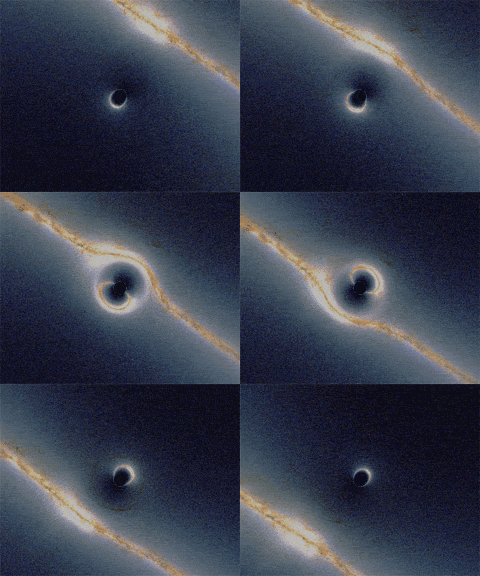
A simulation of gravitational lensing by a black hole
Few cosmic phenomena capture our imaginations like black holes. The subject of countlesssci-fimisadventures, it’s hard to describe a black hole without using grandiose and somewhat misguided metaphors. ‘Cosmic whirlpool’, or ‘deep space vacuum cleaner’ spring to mind along with notions, undoubtedly inspired by the aforementioned movies, that black holes have something vaguely to do with portals to other universes, alien honey pots, or something to make your space-cruiser go faster.
Black holes have been long shrouded in mystery due in no small part to their physics-bending properties.
For an example of some of the misconceptions that surround black holes, you need only look as far as the activation of the Large Hadron Collider, billed by some tabloids as heralding the end of days. “Are we all going to die next Wednesday?” asked the Daily Mail, followed by a blow-by-blow account of how planet Earth could be sucked into a micro black hole, much like the house at the end of Poltergeist.







What people are saying