Louise Ogden

Louise studied for a BSc in Applied Mathematics and Astronomy before realising she was far better at talking about science than actually doing it. Her passion lies in astronomy and the physical sciences, but she has an interest in nearly all aspects of science and health.

[email protected]
Follow Louise on Twitter @LouiseOgden
Find Louise’s blog here www.itsallrelativity.wordpress.com

The levitating train, or SuperTrans II - just one of the topics in this fortnight's podcast

Welcome to this fortnight’s Elements podcast with Beki Hill, Louise Ogden and Richard Masters.

We’ve got everything from goal-line technology and levitating trains to exploding meteorites; fuel crises to the story of Benito Mussolini ridding vast areas of marshland of the malaria parasite.

Listen to find out more, and if you’ve got any comments, questions or ideas for next time we’d love to hear them! Remember to keep up to date with all the stories we talk about, and to find out when the next podcast is up, follow us on Twitter: @elementsscience.

Continue reading »

Catch up on the latest news and interviews on Elements in the past fortnight with Louise Ogden, Beki Hill and Richard Masters.

This time we look at a new approach to therapy, producing bones with a printer, and whether tablet computers are poised to replace your newspaper.

Image of Zebrafish retina. One of the Wellcome Collection Image Award winners. Rights: (Kara Cerveny/Wellcome Images).

Continue reading »

Previously Elements brought you the latest on our understanding of chimpanzee tool use. We know, for example, that chimpanzees will use tools to access food, such as nuts, that they cannot open with their teeth alone. Now it seems they are also highly selective about what tools they use depending on the goal and availability of raw materials in their local environment. Elements caught up with primatologist Kathelijne Koops to learn about the latest culinary delights chimpanzees have on the table thanks to their utensils.


Continue reading »

Welcome to the first ever Elements podcast brought to you by Louise Ogden, Beki Hill and Richard Masters. Every fortnight, we’ll be bringing you the hot topics from the website as well as interviews with some of the contributors and experts from the field.

This fortnight, we delve into the slimy world of hermaphrodite slug sex, discover how a morsel of poo could save someone’s life and determine whether determinism is affected by neuroscience.

Plus, we find out what will be coming up on the site in the next week.

Continue reading »

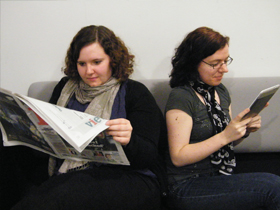
Louise reading a newspaper and Anne-Kathrin reading her kindle, sitting back to back on a sofa

Newspaper or Tablet? Are e-readers the wave of the future?

Tablet computers have become the latest must have gadget to hit the shelves. There are rumours that the iPad 2.0 is soon to be launched by Apple following the success of the original, as well as a multitude of competing tablets launching every month.

There is even a newspaper created exclusively for and distributed solely by the iPad, which was launched by News Corporation earlier this month.

Elements resident technology experts, Anka Lindemann and Louise Ogden, have differing views on the advantages of a tablet computer, and discuss the pros and cons of the devices below.

Anka:

Why don’t you like tablet computers? They’re a great multimedia jukebox that you can easily carry around with you all the time. And you can even surf the web with them wherever you are and download new films, songs, books and games – whatever you want!

Okay, so they are not primarily designed for working-on-the-go. You probably wouldn’t write your dissertation on a tablet, but for watching a movie on a train ride, reading your daily newspaper and flipping through your photo collection, a tablet is all you need. And they are also much lighter than a comparable netbook since they don’t need a keyboard and touchpad. Continue reading »

Memberships

Member Button linking to the Association of British Science Writers (ABSW) - an association of science writers, journalists, broadcasters and science-based communications professionals - many of whom are available for freelance work