






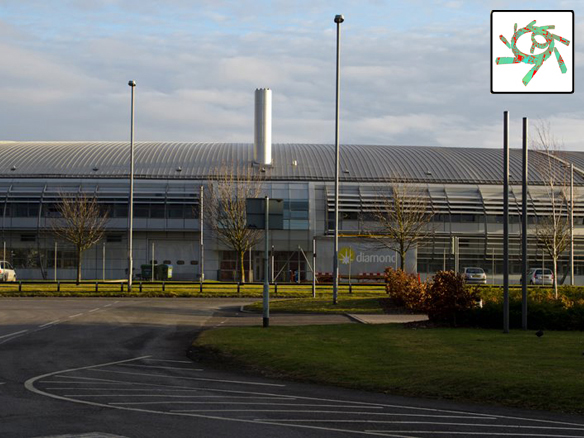
Since Diamond Light Source in Oxfordshire is filled with scientists, you’d be forgiven for mistaking it as an in-house research operation.
Actually, the UK’s largest synchrotron focuses on supporting outside researchers - both corporate and public, national and foreign. Around 2,000 external scientists use Diamond’s facilities each year, for research ranging from bioscience to earth and environmental sciences.
Diamond currently operates 22 beamlines, a number set to rise to 32 by 2018. In the meantime, a long queue of external scientists is forming around Diamond’s doughnut-shaped exterior. Twice a year, Diamond calls for researchers to submit application proposals to use the beamlines.
These proposals will then be reviewed and graded by a peer review panel consisting of reputable scientists with synchrotron experience.
Dr Tina Geraki, a support scientist at Diamond who assists the researchers on the beamlines, says that the amount of time that successful applicants get on a beamline varies.
“Groups may get a few hours or a few days depending on [the availability of the] beamline, project, etc,” she explains.
Learning to operate the beamline
Dr Geraki spends a number of hours, sometimes longer, training external scientists on how to use a beamline and its software in order to get the best possible data.
“When you first visit the beamline it can be very daunting,” admits Dr Andy Neal from Rothamsted Research, who has conducted research at Diamond. “After a while, the routine processes become familiar but there’s always a worry about encountering a problem that you haven’t come across before.”
Dr Neal is currently running several projects at Diamond: one of them is finding ways to improve the nutritional quality of cereals. He is studying wheat grain to examine the distribution of essential nutrients such as iron and zinc in the grains.
Dr Po-Wah So of King’s College London, an imaging scientist, was less intimidated by the equipment at Diamond. “With good training and technical support on hand, one can readily operate the beamline,” she notes.
Her research is looking into the role of metals in human tissue, particularly iron, in diseases such as the Alzheimer’s and Parkinson’s.
“[We are focusing] on the development or application of magnetic resonance imaging (MRI) techniques to study these diseases,” said Dr So. “MRI can provide a ‘window’ into the body to visualise biological processes without the need for invasive [medical tests].”
Beamline vital in research
The beamline has helped scientists to gather crucial data for their work. Dr Neal and his team have used the synchrotron to collect information directly from the grain tissue for their wheat grain project.
Before the beamlines came along, they were only able to obtain information from samples that were extracted by dissecting different grain tissues. Dr Neal said the downside to this method is the tissues might get contaminated by other tissues.
However, Dr Neal and his team did not achieve what they wanted the first time they used the beamline.
“On the beamline I used, the problem is that every visiting scientist has a different experiment to perform and so there is no standard method - everything has to be worked out from scratch. This means that you only start to get the best data after a few visits.”
Even so, Dr Neal argues that the beamline has been useful in his research and his team have been able to study genetically modified grain that contains higher iron and zinc content.
For Dr So, Diamond’s facilities helped in the interpretation of MRI data, allowing an evaluation of how effective MRI is at discerning levels of iron in the diseases.
“I was delighted with our data from our first time at Diamond,” Dr So reports. “Not only was there wonderful support from the beamline scientists, many of the individuals my team met… were very helpful and friendly… Truly, a gem!”
Image: author’s own
For more, see Elements’ special report on Diamond Light Source.