






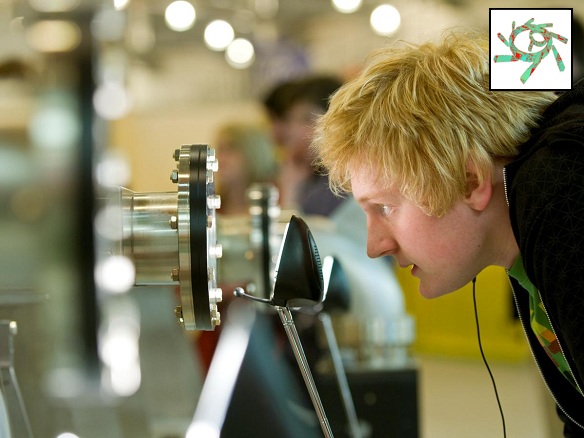
Throughout the year, Diamond Light’s doors are opened to students to tour the facility and learn about the science and engineering going on inside.
Students explore the beamlines; look inside the accelerator; and talk to researchers about the work they do, in a bid to educate and inspire them.
Outreach manager Laura Holland and an engineer from the synchrotron spoke about the importance of engineering and how Diamond Light attempts to engage students and raise its public profile.
Full transcript:
Jinan Harb:
Engineering - what does it mean to you?
In a recent survey, when asked what engineering developments of the last 50 years had had a significant impact on their lives, 52% of men and 71% of women couldn’t name one.
The outreach programme at Diamond Light aims to target this lack of interest in science and engineering by involving the public and arranging visits and talking at festivals.
The programme specifically targets A-level students with visits to the facility to give them a real taste of what goes on inside the giant doughnut.
Large school events are arranged three times a year, where the teenagers are invited to tour the facility and talk to the experts. Visits are also timed to ensure the pupils get to have a look inside the accelerator itself too! Outreach manager Laura Holland told me that in 2012 around 2,000 students are expected to visit the synchrotron.
Stewart Scott, a mechanical engineer at Diamond Light, said it’s a really useful time for the children to ask some burning questions and get involved.
Stuart Scott:
Schoolchildren from local schools come here for the day to get involved in various engineering activities. So we have a number of different companies come here, including BP and the space science people at Rutherford, and they spend an hour with the children and do some sort of interactive session. And it gives the kids an idea of what engineering is all about, be able to talk to real engineers about “what do you do” and “how much do you get paid” and all these sorts of things.
Jinan Harb:
Laura Holland said it’s incredibly important to show the children that it’s not all “hard hats and bridges” and that actually there are so many careers available to engineers. And that being able to show how diverse it is is really key. Engineer Stewart Scott added that at a time of great change to university fees and admissions, its really important to inform students of the potential within engineering and helping them secure a job.
Stuart Scott:
The problem of having to pay a lot of money to go to university is maybe making people think twice, and it may mean that people think more about the subject and perhaps choose something where they think that, well, this may lead to an actual job at the end of it rather than it being just of interest in its own academic way. Which is a difficult thing because we don’t want people not to study history or geography or latin. But at the end of he day, we still need people to come out of the various educational establishments providing the skills that the UK PLC needs. And at the moment we still need a wide range of engineering skills both from the technician level, from apprenticeships, degree-level, Masters and PhD-levels. We need all of those.
Jinan Harb:
Stuart was also key to highlight that, although there is a shortage of engineers in the UK, we are still front-runners in some fields and that this work needs to be highlighted and celebrated.
Stuart Scott:
Perhaps it’s not so obvious that you don’t walk down the high street and see engineering companies because they tend to be in factories that look like B&Q. So, for example, if you go to the Rolls Royce factory in Glasgow, where they make turbine blades for 70 per cent of the world’s aircraft, from the outside it could be B&Q, but it’s only when you go inside there and you see the technology involved, and the skills that the UK has, that you can appreciate that we are world leaders in some fields. It’s a very easy thing to knock engineering in the UK but what we need more people to do is stand up and say “yes, its not as good as we would like, we would still like to go further, but there still are a lot of companies in the UK which are at the forefront of technology”. Even, if you take the humble car, how many companies are building cars in the UK? It’s a lot, we are producing more cars now than we have ever done in our history.
Jinan Harb:
The engineering sector makes up nearly a fifth of the UK economy and employs over 5 million people across more than 500,000 enterprises. Stewart Scott also spoke about the importance of engineering and the potential it has in many fields.
Stuart Scott:
I think there is a lot of areas. We’ve talked about the aerospace, there’s a lot of development in cars and all of the infrastructure of cars. But I think another huge area that people don’t realise is medical device development. So, people are living longer, and people expect to have the ability to have and maintain that good standard of life. Now we talk about artificial knees, artificial hips, artificial skin, artificial eyes, heart. You know, there is almost no area of our human body which cannot be helped when things go wrong, by medical engineering.
Jinan Harb:
Research from the UK Commission for Employment and Skills recently showed that by the year 2017, 58% of new jobs will be in the fields of Science, Technology and Engineering; which is perhaps why it is increasingly important to ensure that children are aware of the potential skills and jobs there are in these fields. This also highlights the importance of schemes such as Diamond’s Outreach programme looking to inspire children at a time when they are making major decisions into their future.
Although it might be difficult to get direct feedback from the single sessions run by Diamond’s Outreach programme, manager Laura was keen to highlight that a good experience at the time will hopefully lead to a positive attitude towards science and engineering in the longer term. She also noted, that she recently caught up with a couple of visitors in a chance meeting at a science fair, and said they were “very proud” to tell her, that they “still remembered what they learnt at the synchrotron, that water was made up of two hydrogen atoms and one oxygen”.
For more, see Elements’ special report on Diamond Light Source.