






A new imaging technique has begun to reveal how the billions of critters in the human mouth socialise with one another.
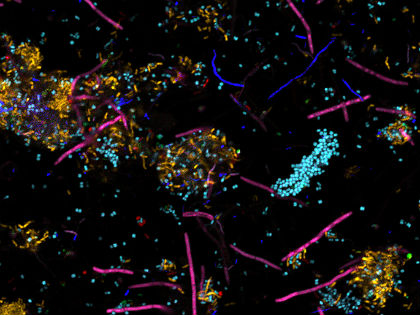
This image (right) was created using a technique called CLASI (combinatorial labelling and spectral imaging). It shows some of the bacteria from a volunteer’s dental floss after he had abstained from brushing his teeth for a full day. Fifteen species of bacteria are represented, only a fraction of the estimated 25,000 species in our saliva and on our teeth.
The confetti pattern of the image reveals which bacteria are close compatriots and which are loners. This kind of information is useful in understanding dental problems, such as plaque.
The microbes that make up dental plaque form what is called a biofilm, a thin layer of tightly bonded cells. Microbes behave differently in a biofilm than when just floating around in saliva. And much of their behaviour – including bad behaviour like causing cavities and periodontal disease – will be determined by the microbes they’re associating with.
In living colour
The new imaging technique is based on an existing kind of fluorescent snapshot called FISH (fluorescence in situ hybridisation). In FISH, researchers design tiny artificial bits of DNA with a fluorescent molecule attached. This DNA specifically matches only one kind of bacteria. So, it will bind to those bacteria and “tag” them, like in a Facebook photo.
However, with traditional FISH, only three kinds of bacteria could be tagged at any one time. Imagine a photograph of everyone you’ve ever gone to school with – and only you and two friends can be tagged in it.
CLASI takes things up a notch. Developed by Alex Valm and colleagues at Marine Biological Laboratory in Woods Hole, Massachusetts, CLASI allows up to 25 different bacteria to be tagged in a photo, greatly increasing the information the image can provide. Eventually Valm intends to increase that to 100.
The future of bacterial maps
The researchers are already beginning to apply the CLASI technique to other microbial hotspots in the body, including the intestines and skin. Their work is helped along by the Human Microbiome Project, which is genetically sequencing microbes from these particular body sites, along with oral, vaginal and nasal microbes.
Surprisingly little is known about the bacteria that coexist on and inside our bodies. This is despite the fact that many of them contribute to the daily functioning of our organs, while many others cause common diseases.
As more of the bacterial cargo on humans is identified, there will be even greater need for understanding how they function as a group, and CLASI may just be what researchers will use to take their group picture.
Image by Alex Valm