
As simple as putting on a plaster?
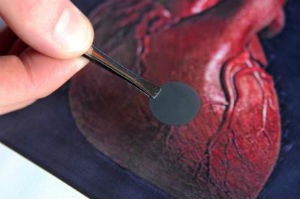
Scientists from Brown University, USA have developed a synthetic nanopatch that could help regenerate heart tissue left damaged after a heart attack. About the size of a penny, the patch consists of intricately interwoven carbon nanofibres glued together with a polymer known as poly lactic-co-glycolic acid.
During a myocardial infarction, or heart attack, the heart’s blood supply is interrupted. This can cause both heart nerve cells and cardiomyocytes (cells that spontaneously expand and contract, giving the heart its natural rhythm) to die. At present, surgeons can’t repair this affected area, and can only resort to temporary treatments, such as coronary artery bypass graft (CABG), which are invasive and risky.
In order to create the patch, engineers at Brown and the India Institute of Technology Kanpur used carbon nanofibres - helical-shaped tubes - with diameters between 60 and 200 nanometres (the smallest bacteria are about 200nm). These work well as they replicate the kind of electrical conductivity essential for the heart to maintain a steady beat.
In a series of lab tests, researchers found that after four hours, five times as many heart tissue cells colonised the cardiomyocyte-seeded nanofibre patch than a control sample consisting of the polymer alone.
“The scaffold works because it is elastic and durable, and can thus expand and contract much like heart tissue,” said Thomas Webster, associate professor in engineering and orthopaedics, one of the authors on the paper.
These properties, in conjunction with the nanofibre make-up of the patch allowed cardiomyocytes and neurons to congregate on the scaffold, spawning new cells. This can help essentially regenerate the affected area.
“This whole idea is to put something where dead tissue is to help regenerate it, so that you eventually have a healthy heart,” said David Stout, a graduate student in the School of Engineering at Brown and the lead author of the paper published in Acta Biomaterialia.
Image courtesy of: Frank Mullin, Brown University
 Stout, D., Basu, B., & Webster, T. (2011). Poly Lactic-Co-Glycolic Acid: Carbon Nanofiber Composites for Myocardial Tissue Engineering Applications Acta Biomaterialia DOI: 10.1016/j.actbio.2011.04.028
Other Elements articles in which you might be interested:





What people are saying