
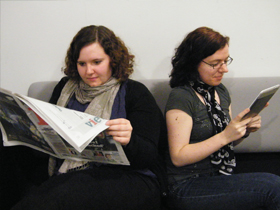
Newspaper or Tablet? Are e-readers the wave of the future?
Tablet computers have become the latest must have gadget to hit the shelves. There are rumours that the iPad 2.0 is soon to be launched by Apple following the success of the original, as well as a multitude of competing tablets launching every month.
There is even a newspaper created exclusively for and distributed solely by the iPad, which was launched by News Corporation earlier this month.
Elements resident technology experts, Anka Lindemann and Louise Ogden, have differing views on the advantages of a tablet computer, and discuss the pros and cons of the devices below.
Anka:
Why don’t you like tablet computers? They’re a great multimedia jukebox that you can easily carry around with you all the time. And you can even surf the web with them wherever you are and download new films, songs, books and games – whatever you want!
Okay, so they are not primarily designed for working-on-the-go. You probably wouldn’t write your dissertation on a tablet, but for watching a movie on a train ride, reading your daily newspaper and flipping through your photo collection, a tablet is all you need. And they are also much lighter than a comparable netbook since they don’t need a keyboard and touchpad.
So if you are looking for something that you will mainly use for entertainment, go for a light tablet and your bag will be less heavy.
Louise:
But they’re not as light as a newspaper or a magazine. You’re right, you can’t work or study on a tablet computer. They are, supposedly, multimedia devices, which are great for movie-lovers and web surfers alike, but that seems pointless if you can’t work on them for any length of time. Using the iPad’s screen as a keyboard requires you to bend over the tablet, creating a bad body posture for the user, hardly what you want from a computer.
Another thing about the iPad is that it is missing USB ports, a frustrating omission for those wanting to transfer material using their pen drive, or to connect their printer to their tablet. Of course, the reason for this is because there are USB ports on the iPad dock, which, rather annoyingly, is sold separately.
Anka:
Well, it’s typical that you have to buy every adapter and dock separately for Apple…but this doesn’t make the iPad less successful – it is still selling like hotcakes. Just on the day of its release in April last year, Apple sold more than 300,000 iPads and more than one million apps for it – that makes an average of three to four apps per user on the first day. And up to late December 2010, Apple sold almost 15 million iPads in total, with over 7 million during the pre-Christmas period alone.
Louise:
Well, if the expensive accessories or the weight of carrying around a tablet doesn’t put you off, perhaps the security risk will. Muggings in London went up by 8.4 per cent in 2010, a statistic that probably can’t be fully attributed to tablet computer use, but it would seem likely that the increase in mobile technology over the last year will have led to a rise in theft and robbery.
Anka:
But who says you can only use a tablet on the go? Tablet computers are also a nice way of enjoying your media collection at home, without bending over a laptop or desktop computer. A small dataset published by the application Read it Later even suggests, that using a tablet changes your reading behaviour! Instead of reading the article in the moment, tablet users bookmark the material to read it later in the day.
Well, these findings are not completely representative for all tablet users, but it shows a trend in changing media use habits: Instead of consuming news sitting in front of your computer during the day, you can curl up on your couch with a tablet in the evening and look through the material you stumbled over earlier.
Louise:
Well, I suppose the one tablet that is well designed for reading is Amazon’s highly successful Kindle, but it is hard to argue that it sits in the same league as the iPad. Not strictly a tablet, I would argue that the Kindle is primarily an eReader, with the added bonus of limited web surfing capabilities.

Eye-friendly e-ink or the smell of the printing press?
The Kindle’s success can be put down to its small size, eye-friendly e-Ink, and comparatively low price, but if you want to use your Kindle to watch TV online or flick through your photo album, you will be hugely disappointed.
I could be tempted to buy a Kindle, but nothing beats opening a brand new book and getting the waves of scent that only a new book holds. The same goes for newspapers. Knowing that every morning I’ll get the satisfaction of opening up my newspaper for the first time; taking in the smell of the printing press is something a tablet can never replicate.
Anka:
And with the smell of the newspaper you get inky fingers and higher and higher piles of old papers… I mean, if you really love the smell and the feel of a newspaper, than a tablet might disappoint you. But there are so many advantages in reading a newspaper or a journal on a tablet. First of all, no more inky fingers – and no black stains on white linen, shirts and trousers.
And one thing that has always annoyed me about newspapers, is the huge size of the broadsheets. I am a small person, and if I want to turn the pages of a broadsheet and I don’t have a table to put it on, reading a broadsheet feels like I am doing a weird yoga exercise. And how am I supposed to read it on the tube without knocking someone down? A tablet computer solves all these problems.
Louise:
I may get inky fingers from newspapers but think of the amount of bacteria you are pushing around the screen of your iPad. A study in 2010, showed that viruses are easily spread on surfaces like the touch screen of a phone or iPad. They found that when participants touched a glass surface that had had a virus spread across it, they would pick up 30 per cent of the virus on their fingertips. You have to admit, that is pretty gross.
Anka:
But you can get viruses and bacteria from everywhere. Just think of your computer keyboard – a study from 2008 shows, that in a University between four and five colonies of bacteria live on 1cm2 of a computer keyboard – and if it was a shared computer, this number increased to more than 20 colonies!
We just cannot escape bacteria; if you don’t pick them up from your tablet, you will catch them from somewhere else. I mean, from your point of view a tablet might not be very hygienic, but this is a problem that we have to live with every day and everywhere we are.
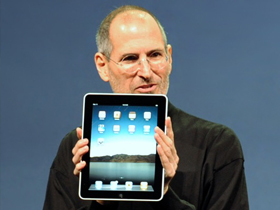
Pride and Joy: Steve Jobs' new ipad is facing growing competition in the tablet market
And it does not seem to reduce the high demand for tablets. After the huge success of the iPad, other companies have also launched promising tablets, like the Samsung Galaxy Tab. It is based on the Google mobile-phone software Android and Google just recently presented a new version of this software, Android 3.0 or “Honeycomb”, which experts see as a serious competitor to market leader Apple.
Although neither Google, nor one of the other companies which will use Honeycomb have given a launch date of the first Android 3.0-based tablets yet, we can expect that the sales of tablets will continue to rise.
Louise:
But then you also have other companies who are already recognising the limitations of tablet computers. The Dell Inspiron Duo, which combines the keyboard of a laptop with the touch screen of a tablet, has recently been released, following the realisation that typing on a tablet is uncomfortable and impractical.
Anka:
Trying to combine a tablet and a netbook seems like an interesting compromise. But I don’t think that it will reduce the success of tablets. They are manufactured for a specific need, which hasn’t got much to do with working on a computer. Tablets are unlikely to replace “normal” computers or laptops, but they will have an influence on how future computers will be designed, especially if it comes to features like the touch screen.
Louise:
Perhaps you’re right, and this will be the start of a new type of computer design with a new user-friendly operating system. But, for now at least, a tablet is still a luxury item for most people, another piece of technology to add to the collection. Somewhere between a smartphone and a netbook laptop, tablets provide very little new to an already saturated market. And with increasing improvements and rumoured updates, I think it would probably be wise to wait a while before emptying your wallet for an oversized iPhone.
Photgraphs: Debora Miranda
Image: Matt Buchanan
Research
Julian, T., Leckie, J., & Boehm, A. (2010). Virus transfer between fingerpads and fomites Journal of Applied Microbiology, 109 (6), 1868-1874 DOI: 10.1111/j.1365-2672.2010.04814.x
Anderson, G., & Palombo, E. (2009). Microbial contamination of computer keyboards in a university setting American Journal of Infection Control, 37 (6), 507-509 DOI: 10.1016/j.ajic.2008.10.032
Other Elements articles in which you might be interested:


Hi Sam, thanks for your comment. You’re totally right - the BB playbook will be a very interesting device once launched. I’ll be interested to see what the sales will be like. I can’t decide whether its size will work in its favour or against it. But I’d like to get my hands on one to see.
Hi Phil, thanks for your comment. You’re probably right - we should agree to disagree just as Anka and I did. I think you make a good point though, that these types of devices, are very user-specific. We all use our tablets, smartphones, netbooks and laptops for different things and in different ways. Although, I have to say, if I was in your situation I would probably use a pen and paper rather than a tablet to make quick notes on-the-go.
I’m scared of new technology like this. I have gone backwards in getting a rubbish phone over a smart one, I hate sat nav and I am definitely not going to get a tablet computer thing.
Like many of my colleagues, I still love the touch of paper on my skin, the smell of the print as I flick through the pages and, probably the clincher, I love scribbling notes using a pen. And a pen and paper is probably lighter than these tablets, although not by much as the technology improves.
‘McGuinness
I, for one, have written a good chunck of my dissertation and done most of the reading for it on a tablet. Arguably, it fits my discipline and my very bizarre workflow, based on pacing while reading and writing in my head while walking the streets and then stopping to quickly write everything down on as light a device as possible. A netbook could be better for the second task, but the tablet works fairly well, and there is no question that it is better for the purpose of reading and annotating all those PDFs. My point is that the agreement that tablets are not for work sounds weird to my ears, and that everyone has a different style and needs, especially if we discuss a dissertation, where you are lucky if your main obstacle is typing speed and not some quirk that requires a less-than-ideally-rational workflow. Why can’t we just agree to disagree on which device works best for us?
This was an enjoyable read. I am personally looking forward to the release of the BlackBerry PlayBook. It seems like they have done a good job combining practical uses such as document editing, and web browsing, with entertainment elements.
[...] here to see the original: The pros and cons of tablet computers | Elements Leave a comment | Trackback No comments [...]
[...] This post was mentioned on Twitter by Débora Miranda and Rebecca Hill, Richard Masters. Richard Masters said: The pros and cons of tablet computers http://t.co/KqAp3x3 via @AddThis [...]