

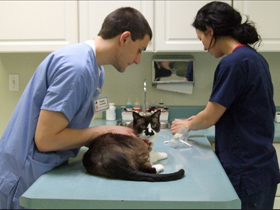
Shedding more than fur: your feline friend could be harbouring MRSA and might have picked it up from you
Methicillin-resistant Staphylococcus Aureus (MRSA) can be passed from humans to animals and is as much a problem in veterinary surgeries as in hospitals.
The MRSA infection causes great trepidation in many patients admitted to hospital. Evidence has shown that MRSA can also be carried by animals and passed on to people who come in contact with them.
The bacteria Staphylococcus can be detected in around 30 per cent of people, usually found around the genital area and nasal passages, and have no detrimental effect. An infection occurs when the bacteria gain access to the blood stream through an open wound, travelling to the body’s major organs where they can cause harm.
S. aureus is often found naturally in the body and MRSA is no more pathogenic than other strains of Staphylococcus. However, the bacteria have developed a resistance to antimicrobials making them harder to treat.
MRSA is now a problem in hospitals worldwide where there are many ill people in close proximity. These patients often have weakened immune systems and sites for easy bacterial entry like surgical wounds and intravenous treatment lines. The bacteria are easily picked up by people without realising making infection hard to control.
The occurrence in animals has been acknowledged since the late 1990s but has become more common since 2003 and is now a major problem in veterinary clinics. The strain and mode of transmission are no different to those seen in humans. MRSA clones found in vet’s clinics are the same as those associated with human hospitals allowing transmission to be traced back to pet owners and staff.
There has been national outrage at the levels of MRSA in hospitals, with criticism levelled at slack cleaning standards. Attempts to minimise the bug’s spread have been futile. With some strains now resistant to all antimicrobials available for treatment, the best option is prevention.
In humans the frequency of infection varies between countries. Professor Katharina Staerk, a researcher into the prevention techniques of MRSA at the University of London’s Royal Veterinary College, says: “Countries with vigorous prevention plans have a lower frequency of outbreaks. For example in the Netherlands where prevention is stricter, the levels of infection in hospitals are around 5 per cent, in contrast to the UK at 40 per cent.”
There has been fewer data retrieved on the infection levels of MRSA in pets. According to Professor Staerk: “When a sample of swabs from pets were submitted from clinics throughout a certain county, 9 per cent of the dogs tested were carriers.”
A new strain (ST398) discovered in several countries affects animals used for food; this could lead to further pressure to control of MRSA if it spreads to the UK. The ST398 strain was recognised in 2005 in piglets but has also been seen in broiler chickens, dairy cows and recently in horses. Farm workers can acquire the infection from their animals and transfer it to others.
In the Netherlands vets and farmers admitted to hospital are often quarantined until it is confirmed they are not carrying the bacterium. The strain can also be found in meat products posing a threat to food workers and slaughter houses. In the UK there has not yet been an outbreak, however isolated cases have been reported. A few people in Glasgow were confirmed as carrying the bacterium as well as a horse in the south of England.
All strains of MRSA are a risk to public health and present an immediate need to eliminate these bacterial strains from the environment. The conventional methods of disinfection are labour intensive and often ineffective since MRSA bacteria can survive on surfaces for many months.
The European Commission has funded a team of researchers to develop new techniques to prevent the spread of the bacteria and examine ways of removing MRSA from air and surfaces. They are currently developing a range of self cleaning surfaces and UV light emitting lamps which could be used to cleanse contaminated air.
Research
Seguin JC, Walker RD, Caron JP, Kloos WE, George CG, Hollis RJ, Jones RN, & Pfaller MA (1999). Methicillin-resistant Staphylococcus aureus outbreak in a veterinary teaching hospital: potential human-to-animal transmission. Journal of clinical microbiology, 37 (5), 1459-63 PMID: 10203505
Picture: Jeffrey Beall
Other Elements articles in which you might be interested:


[...] This post was mentioned on Twitter by Jay, Nevada Ozone. Nevada Ozone said: NevadaOzone.com Animals with MRSA – a health problem crossing the species barrier … http://bit.ly/gHvJwE [...]