
Podcast: Play in new window | Download (5.0MB)
By Smitha Peter
Recent studies by Natural England and the European Red List reveal that biodiversity is facing serious threats due to loss of habitat.
According to the first study, 480 of the 492 observed species have gone extinct in the past two centuries. The second one says that almost one-third of butterfly species are in decline. Both reports view industrial agriculture as a major factor, along with hunting, pollution and climate change.
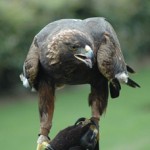
Golden eagle - one of the lost species. Image credit: J. Glover - Atlanta, Georgia
“Mixed farming or rotational farming is the way forward. Diversity is both a measure of increasing production and conservation of nature,” said environmentalist Dr Vandana Shiva in her speech ‘Perils of the industrial agricultural system’ at the Gaia Foundation in London.
She added that small-scale farming is the most sustainable way for agricultural production.
The European Red List report suggests that the shift from traditional farming methods have especially hit insect species like butterflies. “New agricultural techniques provide little or no space for wild plants and flowers to grow. Moreover, it is based on monoculture, where the plant varieties cultivated are often not butterfly friendly,” says Malcolm Bridge from Butterfly Conservation.
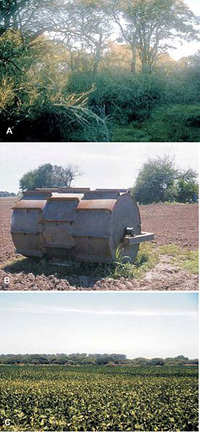
Forest cleared for soybean cultivation. Image credit: Marcelo R. Zak
A study by the Centre for Ecology and Hydrology (CEH) on soil organisms also had interesting results. It stated that although the number of soil bugs increased by 47 per cent in the past 10 years, diversity of bugs has decreased by 11 per cent.
However, scientists warn that further research is needed to be sure of the trend, as the effect of land management, pollution and climate change on soil bugs is not clearly known. The study also observed that there is no significant increase in the number of bugs in arable land, probably due to the regular disruption of their habitat. Diversity of organisms helps the soil cope with pollution and changing weather conditions.
Industrial agriculture is designed to obtain maximum output from minimum input by utilising technological advancements. Production of cheap and plentiful food is viewed as its main benefit.
Audio clip: Adobe Flash Player (version 9 or above) is required to play this audio clip. Download the latest version here. You also need to have JavaScript enabled in your browser.
Other Elements articles in which you might be interested:





Great Post
thought you might like my machinima film the butterfly’s tale~
http://www.youtube.com/watch?v=y1fO8SxQs-E
Bright Blessings
elf ~